Water Parameters
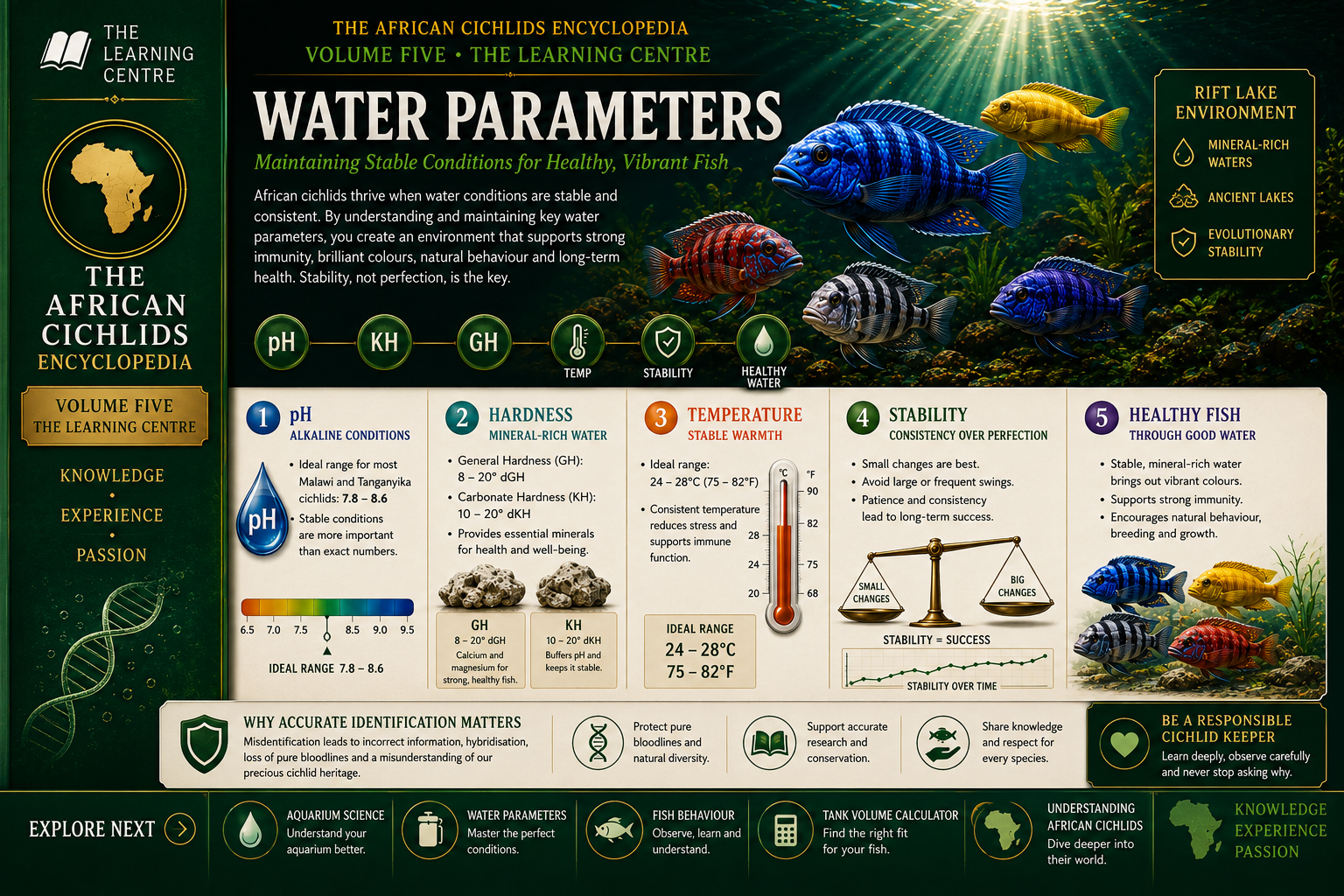
25 Years of Experience: The Lake Malawi Parameter Reference Guide
Maintaining a pristine African cichlid habitat relies entirely on data and monitoring. Over the past twenty-five years, I have seen hobbyists lose beautiful colonies simply because they guessed their water quality instead of measuring it. Lake Malawi is one of the most stable natural aquatic environments on the planet. To replicate this consistency at home, you must maintain a strict, non-negotiable set of water targets. This guide serves as your operational logbook to evaluate your daily water test results and maintain long-term stability.
"In the Learning Centre, we track the numbers that matter. Your test kits do not lie. By keeping a weekly log of your exact parameters, you can intercept water quality drops weeks before they manifest as a disease outbreak or a sudden spike in community aggression."
The Master Parameter Target Matrix
Unlike standard tropical fish that tolerate wide swings in water quality, Lake Malawi cichlids require strict, elevated boundaries. Use the data sheet below as the definitive blueprint for your liquid testing routines:
Understanding the Operational Ranges
While the numbers above give you precise targets, understanding the physical reality of how these metrics interact inside your system is what separates a novice from an expert:
- The Temperature Dilemma: Malawi cichlids thrive best at a stable 25–26°C. While they can easily survive higher summer temperatures up to 29°C, warmer water physically holds less dissolved oxygen. Because a heavily stocked Malawi tank consumes immense amounts of oxygen, any temperature rise must be instantly met with increased surface agitation from wavemakers or bubblers to prevent mass suffocation.
- The Nitrate Ceiling: Keeping nitrates under 20 ppm is your single best defense against chronic diseases and low color expression. If your weekly test shows nitrates pushing past 40 ppm, your water volume replacements are falling short of your feeding inputs. You must either increase your weekly water change volume or reduce your stocking bioload.
- The Stability Imperative: If you test your water and find the pH sits at 7.9 instead of the ideal 8.2, do not aggressively throw chemical adjusters into the water. A stable, unmoving pH of 7.9 is infinitely safer for your fish than a fluctuating environment that swings wildly from 7.9 to 8.4 and back down in a single day. Make all chemical adjustments slowly over a period of several days.
Operational Parameter Checklist
Follow these testing rules to maintain flawless tracking integrity of your biological and chemical values.
- [ ] Liquid Testing Kits Only: Are you using accurate, liquid-reagent testing drops instead of cheap paper multi-strips?
→ Operational Value: Paper strips are notorious for absorbing ambient room humidity, which causes highly inaccurate pH and hardness readings that mask hidden parameters. - [ ] Testing Schedule Rhythm: Do you perform your water tests at the exact same time of day, right before your weekly water change?
→ Operational Value: Testing water at its absolute "dirtiest" phase right before a maintenance purge gives you the truest representation of your system's baseline filter capacity. - [ ] Source Water Verification: Do you test your raw tap or well water source twice a year (summer and winter)?
→ Operational Value: Municipal water treatment centers often alter their chemical treatments seasonally, meaning your source water parameters can suddenly change without warning.