Compatibility
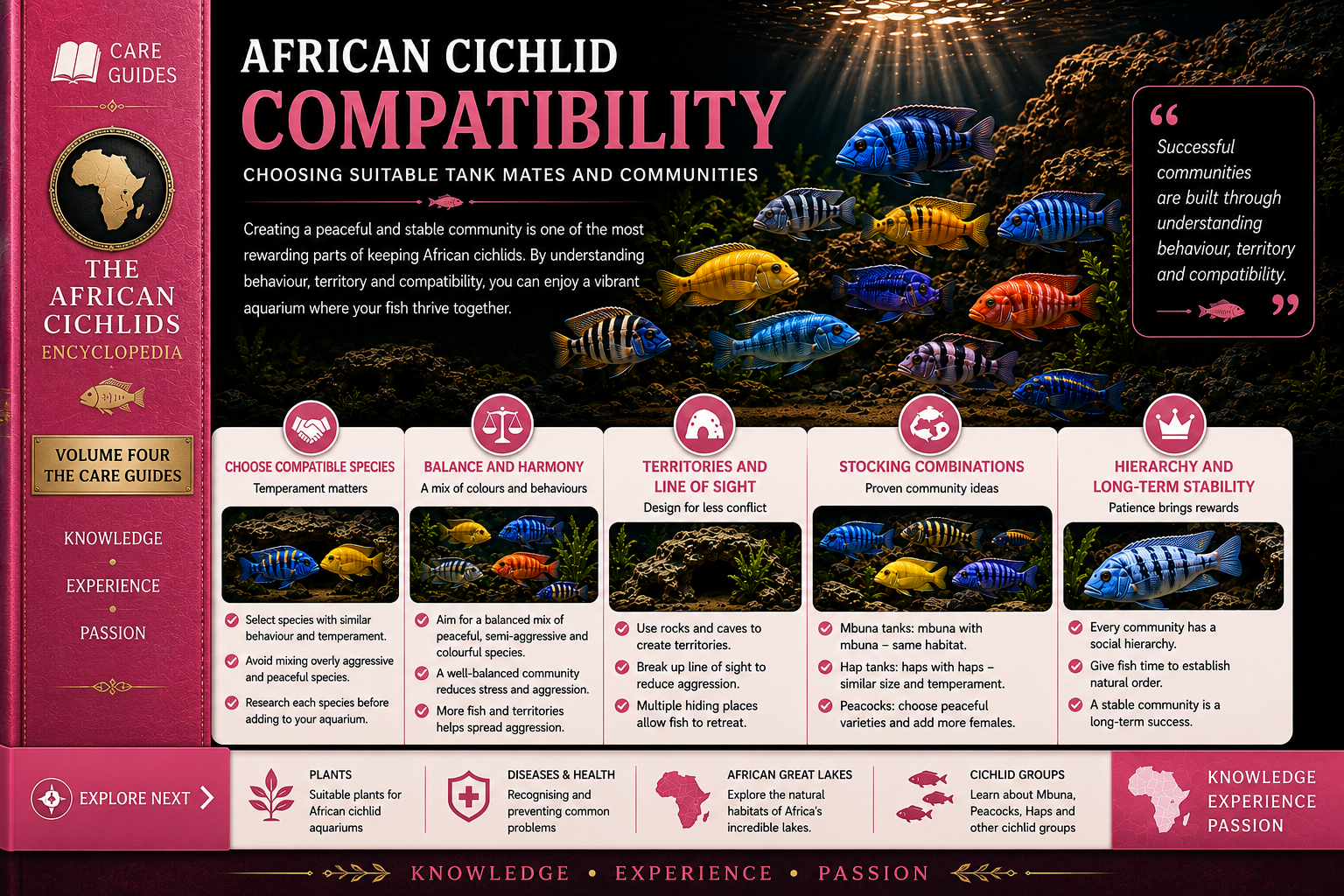
25 Years of Experience: The Golden Rules of Malawi Compatibility
Over the past quarter-century of maintaining and breeding Lake Malawi cichlids, I have seen almost every stocking configuration imaginable. Success with these vibrant African cichlids does not happen by accident. It requires a strict adherence to their evolutionary programming, social structures, and unique environmental needs. Managing their notorious aggression relies entirely on proper planning rather than luck.
"In twenty-five years of fishkeeping, the single biggest mistake I see hobbyists make is treating Lake Malawi cichlids like standard community fish. They are a complex, specialized group of apex-level competitors. If you respect their evolutionary boundaries, they will reward you with unparalleled color and behavior; if you ignore them, your tank will quickly become a battlefield."
The Harem Ratio: Why Pairs Do Not Work
One of the most persistent myths in the hobby is that fish should be kept in bonded pairs. With Lake Malawi cichlids, buying a single male and a single female is often a death sentence for the female. Males possess an relentless drive to mate and are fiercely territorial. In a standard pair dynamic, the male will focus his constant, aggressive attention entirely on that one female, rapidly exhausting her to the point of illness or death.
To successfully manage this behavior, you must implement a strict harem stocking ratio:
- The Core Ratio: Maintain a minimum of 1 male to 2 or 3 females (1:3 is highly preferred) for each species housed.
- Aggression Dispersion: A larger harem ensures that a dominant male's courtship and territorial aggression are diluted across multiple females, giving individual fish crucial time to rest and recover.
- Visual Isolation: While the male chases one female, the others can retreat out of his direct line of sight to feed or rest.
- Subdominant Males: If you introduce multiple males of the same species, ensure you have enough females (usually 6 or more) and visual barriers to prevent the alpha male from killing his rivals.
The Evolutionary Divide: Mbuna vs. Haps
Lake Malawi has fostered an incredible explosion of biodiversity, resulting in distinct groups of fish that have evolved to occupy completely different ecological niches. The two primary groups most common to hobbyists are the Mbuna (rock-dwellers) and the Haps (open-water Haplochromines). Mixing these two groups in a single aquarium goes directly against millions of years of evolution and rarely ends well.
Understanding their fundamental differences highlights why they remain incompatible in the home aquarium:
- Dietary Clashes: Mbuna are primarily "aufwuchs" grazers, scraping algae and microscopic organisms off rocks. Their long digestive tracts are designed for high-fibre, low-protein diets. Haps, on the other hand, are open-water predators or piscivores that require high-protein diets. Feeding them together inevitably leads to health crises, such as the fatal "Malawi Bloat" in Mbuna forced to consume high-protein pellet foods.
- Temperament and Behavior: Mbuna are hyper-aggressive, hyper-active, and perpetually territorial. They do not respect space. Haps are generally calmer, more deliberate swimmers that can easily become stressed, bullied, or physically damaged by the unrelenting, frantic energy of Mbuna.
- Size Disparities: While Mbuna remain relatively compact (typically 10-13 cm), many Haplochromines grow into massive open-water predators (20-30 cm+). A large predator Hap may eventually view smaller Mbuna as prey, completely disrupting the tank dynamic.
Lake Malawi Compatibility Matrix
To help visualize these complex relationships, use the general compatibility matrix below when planning your stocking lists. Always cross-reference specific species temperaments before purchasing.
Environmental Clashes: Aquascaping for Success
Because Mbuna and Haps evolved in entirely different areas of the lake, they require radically different physical layouts to thrive. Forcing them into a compromise layout compromises the well-being of both groups.
The Mbuna Sanctuary (The Rock Fortress):
Mbuna require an aquarium packed from floor to ceiling with heavy rockwork. They need a continuous matrix of caves, tunnels, and crevices where every individual fish can claim a specific physical hole to call home. Without these sight-breaking rock piles, dominant Mbuna will claim the entire open water column and systematically eliminate tankmates.
The Haplochromine Arena (The Open Water):
Haps require vast, unobstructed swimming space to mimic the open pelagic waters of Lake Malawi. A Hap aquascape should feature a wide, open sand flat with only a few large, isolated rock structures at the boundaries to act as territorial markers. Packing a Hap tank with dense rockwork restricts their natural swimming patterns and can lead to physical injuries as these large, fast-swimming fish dart into tight spaces when startled.
Managing Territorial Aggression During Feeding
In a Lake Malawi tank, feeding time is the ultimate catalyst for territorial warfare. Dominant fish will naturally attempt to lock down the entire aquarium to monopolize the food supply, driving subdominant fish into corners where they starve or get injured. Over my 25 years of managing these setups, I have developed a multi-step feeding strategy to break this territorial dominance:
- The Multi-Point Distraction: Never drop all the food into one spot. If you pour pellets into a single corner, the alpha male will claim that zone. Instead, spread the food rapidly across the entire surface of the water, or use the output flow from your filter return to scatter the food instantly across the whole tank.
- Varying Food Sizes & Buoyancy: Utilize a mix of floating pellets, slow-sinking granules, and rapidly sinking wafers simultaneously. This forces the dominant fish to focus on the surface or mid-water column, allowing the subdominant or brooding females to safely graze on the food that reaches the substrate and rock crevices.
- Feeding the 'Bully' First: If you have one exceptionally aggressive species, drop a small pinch of their favourite high-attractant food in their preferred territory first. While they are occupied defending and consuming that specific patch, feed the rest of the community on the opposite side of the aquarium.