Lake Malawi
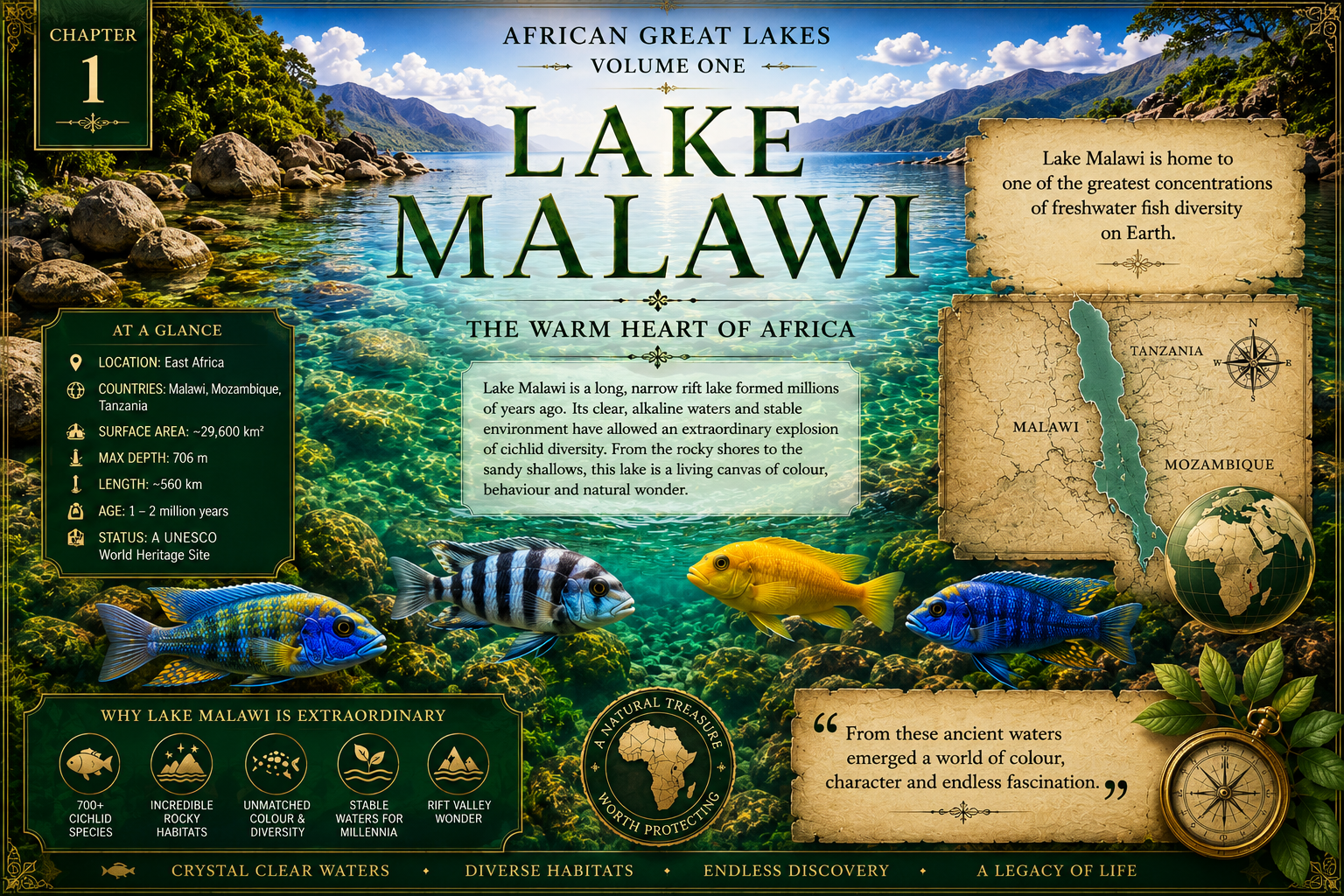
Lake Malawi: The African Inland Sea
Welcome to the heart of the Rift Valley. Lake Malawi is not just a body of water; it is a massive, dynamic inland sea and the single most important evolutionary hotspot for freshwater fish enthusiasts on Earth.
Location & Geography
- The Borderlands: Nestled at the southernmost end of the East African Rift Valley system. It is shared by three countries: Malawi, Tanzania (where it is called Lake Nyasa), and Mozambique (where it is called Lake Niassa).
- Massive Scale: Stretching roughly 580 kilometres (360 miles) long and 75 kilometres (47 miles) wide. It is the third-largest lake in Africa and the ninth-largest freshwater lake in the world.
- Extreme Depth: The lake sits in a deep tectonic fracture. Its deepest point plunges to 706 metres (2,316 feet) near Nkhata Bay. Because it is so deep, the bottom layers of water are completely stagnant and devoid of oxygen (anoxic), meaning all fish life is packed into the upper 200–250 metres.
Weather & Water Conditions
The climate is strictly tropical, divided into a dry season (May to November) and a wet season (December to April). Strong south-easterly winds blow across the water from May to September, creating massive, ocean-like waves.
Native Water Parameters (For Hobbyists)
To mimic Lake Malawi perfectly in a home aquarium, these are the exact environmental figures:
| Parameter | Native Lake Values | Aquarium Target |
|---|---|---|
| Water Temperature | 23°C – 29°C (73°F – 84°F) | 25°C – 26°C (77°F – 79°F) |
| pH (Alkalinity) | 7.7 – 8.6 (Very Alkaline) | 7.8 – 8.5 |
| General Hardness (GH) | 3 – 5 °dGH | 4 – 10 °dGH |
| Carbonate Hardness (KH) | 6 – 8 °dKH | 6 – 12 °dKH |
| Water Clarity | Visibility up to 20 metres | Crystal Clear |
The People & Culture
- The Lake of Stars: In 1859, the explorer David Livingstone famously nicknamed it the "Lake of Stars". He gave it this name because, at night, the thousands of lanterns glowing from local fishermen's wooden boats looked exactly like a reflection of the night sky.
- Languages: The predominant language spoken by the communities along the western shore is Chichewa (the national language of Malawi), alongside ChiTumbuka and ChiYao.
- Life on the Water: The lake is the absolute lifeblood of the region, supporting the livelihoods of over 1.6 million people. Artisanal fishing villages line the sandy shorelines, where generations of families rely on traditional dugout canoes and hand-woven nets to feed their communities.
The Fish: An Evolutionary Survival Story
While aquarium hobbyists focus on colourful Mbuna, Peacocks, and Haps, the lake holds a grand total of 800 to 1,000 distinct fish species.
The Chambo (Oreochromis): This is a group of three closely related, endemic Tilapiine cichlid species (O. Karongae, O. Lidole, and O. Squamipinnis). Chambo is the most famous food fish in Malawi. It is a prized local delicacy, traditionally grilled or stewed and served to welcome guests alongside Nsima (a thick maize porridge).
The Usipa (Engraulicypris Sardella): A tiny, shimmering lake sardine that travels in massive, silver shoals. Local fishermen catch them at night using lanterns to lure them into nets. The beaches are often covered in mats where millions of Usipa are sun-dried to preserve them.
The Kampango (Bagrus Meridionalis): A massive, predatory catfish that can grow up to 1.5 metres long. They hunt at night in the deep rocky zones and are famous for their aggressive parental behaviour, defending their nests from egg-eating cichlids.
Want to see how this habitat is changing? Read our follow-up article: [Lake Malawi: Then vs. Now]