Lake Tanganyika
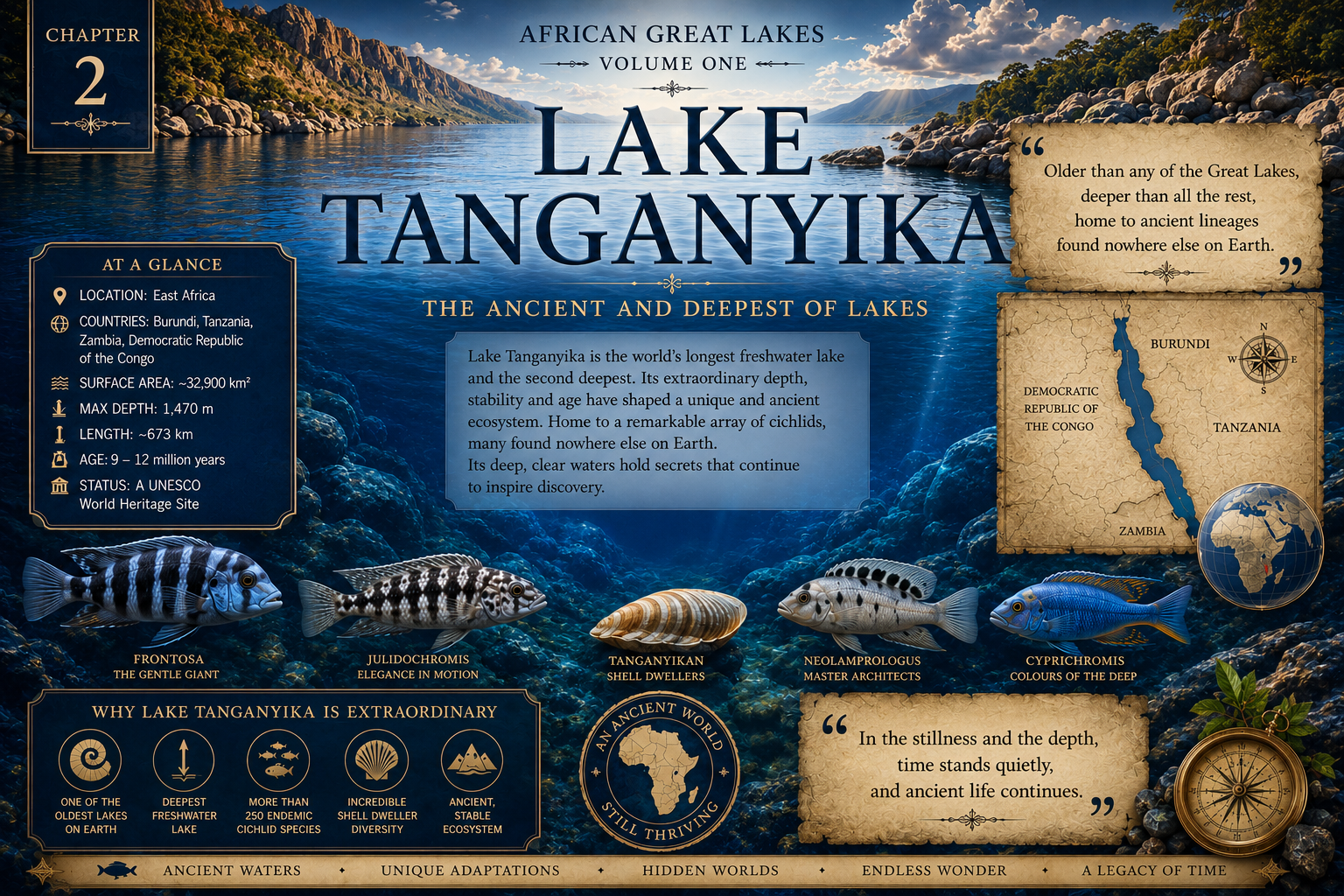
Lake Tanganyika: The Ancient Inland Ocean
Welcome to Lake Tanganyika, an incredible body of water that feels much more like a marine ocean than a freshwater lake. While Lake Malawi holds the crown for sheer colour variety, Tanganyika is prized by scientists and hobbyists as the absolute pinnacle of biological eccentricity, extreme fish behaviour, and evolutionary history.
Location, Scale & Tectonic Depth
- The Four-Nation Highway: Lake Tanganyika forms a massive natural boundary down the Western Rift Valley. This vast body of water is shared across four different African nations, with Tanzania holding nearly half the lake, the Democratic Republic of the Congo controlling forty percent, and the remaining shores bordering Burundi and Zambia.
- World Records: It ranks as the longest freshwater lake on the planet, stretching a massive 673 kilometres or 418 miles from north to south. It is also celebrated as the second largest freshwater lake by volume and the second deepest lake on Earth, dropping down to a stunning depth of 1,470 metres.
- An Ancient Kingdom: Unlike Lake Malawi, which is relatively young, Lake Tanganyika is an ancient fossil lake estimated to be between 9 and 12 million years old. Because it has remained isolated for so long, its wildlife has evolved into incredibly specialized physical forms found nowhere else on Earth.
| Parameter | Native Lake Values | Aquarium Target |
|---|---|---|
| Water Temperature | 24°C – 28°C (75°F – 82°F) | 25°C – 27°C (77°F – 81°F) |
| pH (Alkalinity) | 8.5 – 9.2 (Highly Alkaline) | 8.6 – 9.0 |
| General Hardness (GH) | 7 – 11 °dGH | 10 – 20 °dGH |
| Carbonate Hardness (KH) | 15 – 18 °dKH | 12 – 18 °dKH |
| Water Clarity | Visibility up to 25 metres | Crystal Clear |
The People & Lakeside Culture
- Historical Crossroads: Because it forms a massive trade corridor, the lake has been a cultural meeting point for centuries. The historic port town of Ujiji on the Tanzanian shore is famously where global explorer Henry Morton Stanley tracked down David Livingstone in 1871, uttering the words, "Dr. Livingstone, I presume?"
- A Linguistic Melting Pot: Due to the four bordering nations, the waters serve as a linguistic crossroads. Swahili is the universal trade language across the lake, operating alongside French, Bemba, and Kirundi.
- Life on the Lake: The lake directly supports over 10 million people living within its immediate basin. Coastal life revolves entirely around traditional and commercial fishing, where night fleets populate the deep open horizons with bright lights to harvest fish.
The Fish: Specialized Masters of the Deep
Tanganyika is home to roughly 250 species of cichlids and 150 non-cichlid fish species. Almost 98% of the cichlids are strictly endemic, meaning they do not exist naturally anywhere else in the world. They have evolved highly peculiar lifestyles:
The Shell Dwellers: In the deep sandy bays, millions of empty Neothauma snail shells form massive underwater fields. Tiny cichlids (like Lamprologus multifasciatus, the smallest cichlid in the world) have adapted to live, breed, and hide entirely inside these single shells.
The Tropheus Colonies: Living on the wave-battered, sun-lit rocky shorelines, these hyperactive rock-grazers form complex, tightly-knit social hierarchies. They mimic marine surgeonfish, aggressively defending patches of algae from competing colonies.
The Dagaa / Ndakala (Stolothrissa tanganicae): These tiny, shimmering freshwater sardines roam the open waters in gargantuan schools. They form the absolute backbone of the local human diet. Millions of pounds of Dagaa are caught using night-lanterns and are sun-dried on the beaches to be distributed as a crucial protein source across Central Africa.
The Goliath Tigerfish (Hydrocynus goliath): Sitting at the absolute apex of the lake's open-water food chain, this terrifying non-cichlid predator can grow over 1.5 metres long and sports massive, dagger-like interlocking teeth capable of tearing through large prey.
Climate shifts are actively altering these waters. Read more in our deep dive: [The Changing Face of Lake Tanganyika]