Lighting & Algae Biology
25 Years of Experience: Cultivating the Perfect "Aufwuchs" Blanket
In almost every other sector of the aquarium hobby, algae is treated as a hated enemy. Fishkeepers spend hundreds of pounds on chemicals, UV sterilizers, and blackout timers just to eliminate every trace of green. However, in twenty-five years of maintaining Lake Malawi cichlids—especially the rock-dwelling Mbuna—I have learned that cultivating a healthy, controlled carpet of algae is one of the ultimate secrets to success. Algae mimics their natural habitat, provides vital supplemental nutrition, and encourages spectacular, hardwired foraging behaviors that make these fish so fascinating to watch.
"In the Learning Centre, we look at the natural biology of the rift lakes. In the wild, Mbuna spend up to 70% of their day grazing on 'Aufwuchs'—a complex matrix of algae, diatoms, and microscopic organisms growing over the rocks. If your Malawi rocks are completely sterile and white, you are denying your fish their most basic evolutionary outlet. The goal isn't an algae-free tank; it is growing the right type of algae while keeping your water pristine."
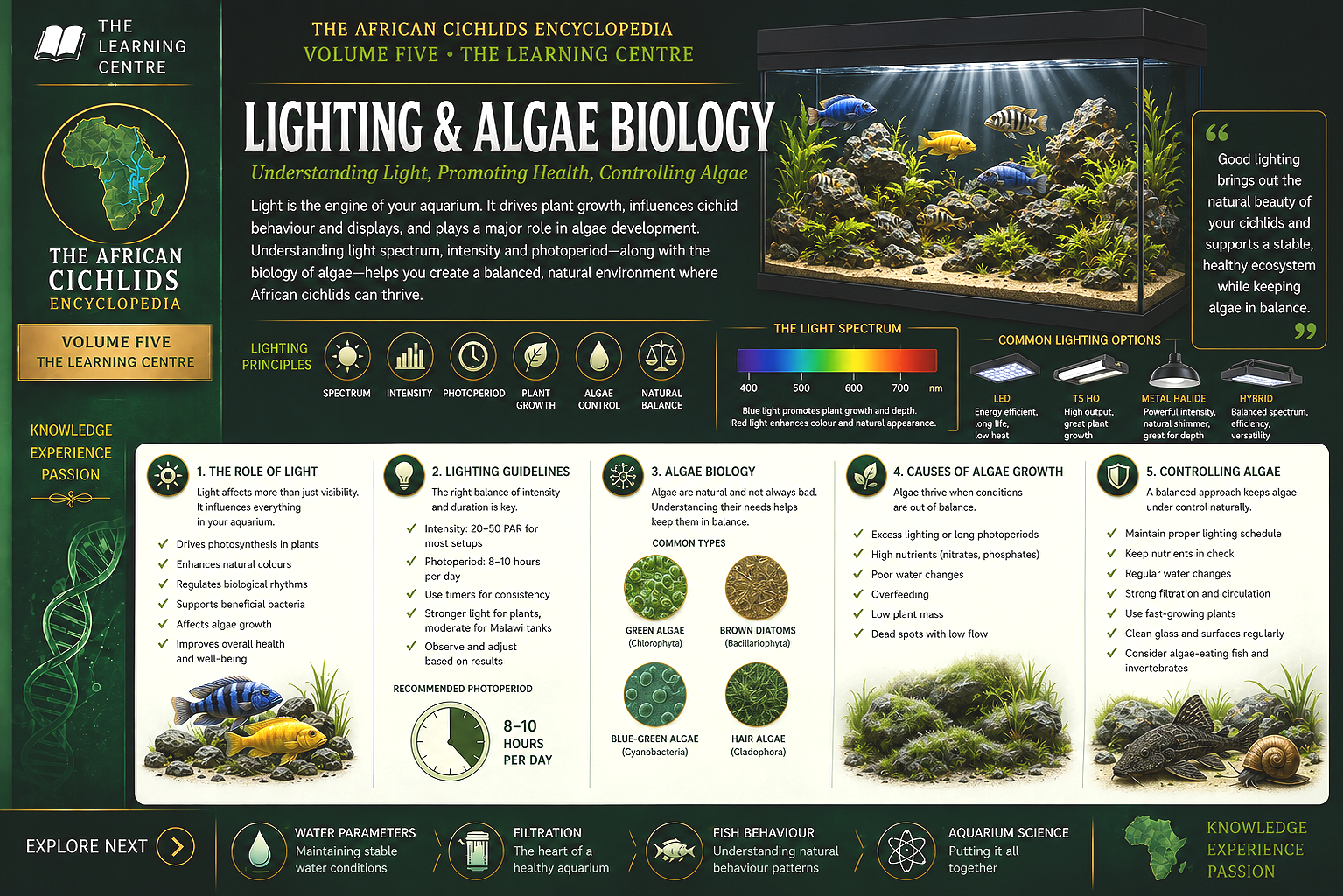
1. The Good vs. The Bad: Decoding Algae Types
Not all algae is created equal. Over the decades, I have categorized the types of algae you will encounter into two distinct groups: those that benefit your cichlids, and those that ruin your water aesthetics.
- Green Turf Algae (Chlorophyta) – The Holy Grail: This is a short, dense, vibrant green carpet that clings tightly to the upper surfaces of your rockwork. It loves high-intensity light and clean water. Mbuna absolutely love to graze on this turf. It does not detach easily, it acts as a secondary biological nitrate sponge, and it looks incredibly natural under modern LED lighting.
- Brown Diatom Algae – The New Tank Phase: This dusty, brownish film covers your sand and lower rocks. It feeds on silicates and is incredibly common in newly set up aquariums. While harmless and easily eaten by young cichlids, it will naturally disappear and give way to green algae once the tank's biological engine fully matures.
- Hair, Film, and Blue-Green Algae – The Enemies: Long, stringy Hair Algae or slimy, dark Cyanobacteria (which is actually a toxic bacteria, not an algae) must be avoided. They are unpalatable to the fish, can choke out your live plants like Anubias, and are a direct symptom of high nitrates, poor water circulation, or incorrect lighting spectrums.
2. Lighting Science: Tuning the Spectrum for Turf
To grow a thick, nutritious green turf without triggering a disastrous green-water (single-celled algae) bloom or a hair algae breakout, you must manipulate both the quality and duration of your aquarium lighting:
- The Kelvin Spectrum: Standard tropical lights emphasize soft pinks and low reds. For a Malawi tank, you want to mimic the blazing African sun slicing through clear water. Aim for an intense light spectrum between 6,500K (Daylight) and 10,000K (Crisp White/Blue). High-PAR modern LED fixtures with a dedicated "planted" or "marine white" spectrum provide the exact wavelengths needed to stimulate rich green turf growth.
- The Photoperiod Strategy: Growing green turf requires energy, which means an extended light cycle. However, leaving high-intensity lights on for 12 straight hours will often trigger hair algae. Instead, utilize a stable 9 to 10-hour photoperiod managed by a digital timer.
- Nitrate Management: Algae cannot grow on light alone; it needs nutrients (phosphates and nitrates). To ensure your intense lighting only grows a clean, short turf, you must keep your nitrates strictly below 20 ppm. High light combined with high nitrates equals a hair algae disaster; high light combined with low nitrates equals a beautiful, tight green carpet.
3. Behavioral and Health Benefits of the Grazing Carpet
Allowing a natural green carpet to mature on your upper rockwork provides massive advantages that go far beyond aesthetics:
- Aggression Redirection: When a tank has an active, edible rock surface, dominant and subdominant fish alike spend their energy continuously nipping and scraping at the stones. This constant foraging activity actively distracts alpha males, drastically lowering the amount of time they spend chasing and bullying tankmates.
- Gastrointestinal Health: As Mbuna scrape the green turf, they ingest valuable trace minerals, vitamins, and high-fiber roughage. This constant, micro-feeding keeps their long, evolutionary digestive tracts moving smoothly, acting as a powerful, entirely natural defense mechanism against the dreaded Malawi Bloat.
Lighting & Algae Biology Checklist
Use these lighting and biological guidelines to establish a safe, beautiful, and functional grazing environment for your cichlids.
- [ ] Lighting Timer Stability: Are your lights operating on a strict, automated daily schedule rather than manual switching?
→ Biological Benefit: Sudden, erratic changes in lighting hours stress the fish and cause opportunistic, erratic hair algae blooms rather than stable turf. - [ ] Rock Orientation: Are your largest, flattest rocks positioned directly under the highest intensity zones of your light fixture?
→ Biological Benefit: Maximizes the surface area exposed to direct PAR light, ensuring a thick, localized green turf blanket where it is most visually appealing and accessible. - [ ] Glass Maintenance Separation: Are you using an algae magnet exclusively on the front and side viewing panels while deliberately leaving the rear glass and rockwork untouched?
→ Biological Benefit: Keeps your viewing windows completely crystal clear for your visitors while preserving the vital biological grazing zones along the back walls and structures.