Equipment & Technology
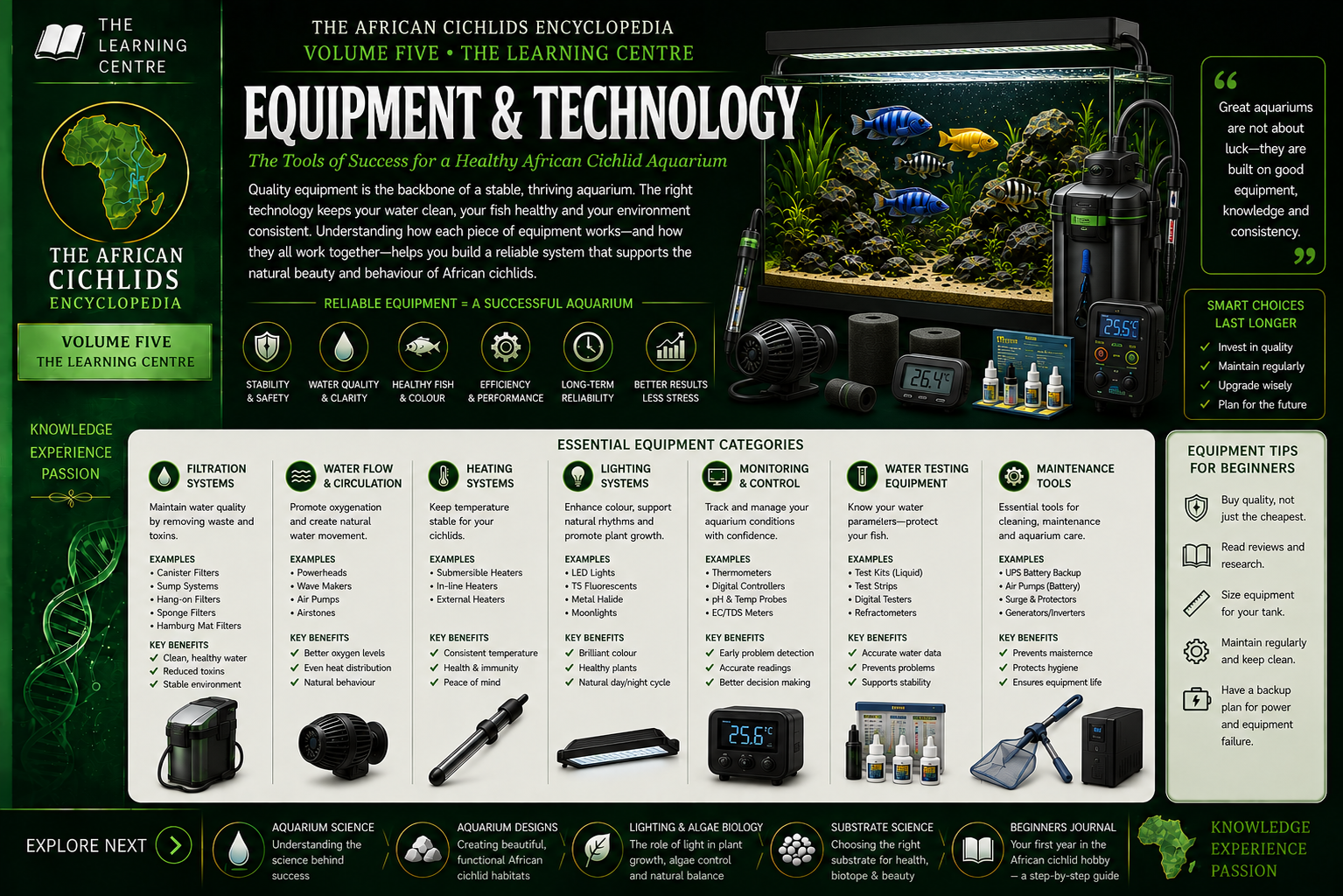
25 Years of Experience: Engineering the Modern Malawi Hardware Matrix
Maintaining a thriving Lake Malawi cichlid system relies heavily on the mechanical life-support systems you choose. Because we deliberately overstock these aquariums to manage aggression, our hardware runs under constant, heavy load. In my twenty-five years of fishkeeping, I have tested almost every piece of aquarium tech on the market. Success doesn't require buying the most expensive gadgets, but it does require understanding which equipment is essential, which items are complete wastes of money, and how to position your gear to prevent mechanical failure.
"In the Learning Centre, we separate marketing hype from practical science. Manufacturers will try to sell you hundreds of pounds of unnecessary electronic gadgets. For a Malawi cichlid tank, you need heavy-duty, reliable workhorses. Prioritise industrial-grade heating, high-volume oxygenation, and durable wavemakers over gimmicks."
1. Essential Gear: The Non-Negotiables
To keep your water parameters stable and your fish safe from their own high-energy behaviours, these three pieces of technology must be selected with strict criteria:
- Dual Commercial Heaters + External Controller: Never rely on a single heater in a large cichlid tank. If it sticks 'on', it will boil your fish; if it fails 'off', a fast temperature drop can trigger an Ich breakout. Use two smaller heaters (e.g., two 200W instead of one 400W) plugged into an external digital temperature controller (like an Inkbird). The controller acts as a master safety switch, cutting power instantly if a heater malfunctions. Always slide a plastic heater guard over the glass tubes to prevent them from shattering when large fish fight nearby.
- Heavy-Duty DC Wavemakers (Powerheads): Standard filter outputs cannot push waste out from a massive matrix of rockwork. You require at least one or two directional wavemakers. Choose modern DC (direct current) pumps; they allow you to electronically pulse or adjust the flow throughout the day, preventing dead waste pockets while giving the fish a natural current to swim against.
- High-Output Linear Air Pumps: Nitrifying bacteria and heavily stocked cichlids consume oxygen at a staggering rate, especially at higher temperatures. A basic, cheap air pump will quickly burn out under the pressure of deep water columns. Invest in a heavy-duty diaphragm or linear air pump hooked up to multiple large, weighted air stones or sponge filters.
2. The Gimmicks: Equipment to Avoid
Over the decades, I have seen many hobbyists waste thousands of pounds on technology that is either completely useless or actively detrimental to a Rift Lake ecosystem:
- CO2 Injection Systems: Carbon dioxide systems are designed to lower pH and provide carbon for complex planted aquariums. Adding CO2 to a Malawi tank will drive your pH down into acidic territory, stripping your KH and suffocating your cichlids. Live cichlid plants like Anubias do not require CO2. Keep this equipment far away from your tank.
- Ultra-High-PAR 'Pro' Planted Lights: Expensive lighting fixtures designed for high-tech aquascaping are completely unnecessary. They produce specific red and deep-blue spectrums that will grow uncontrollable, ugly hair algae or green water in a high-nitrate cichlid tank. Standard daylight LED bars (6,500K–10,000K) are cheaper and far better for growing clean green turf.
- Delicate Electronic Substrate Cleaners: Motorized gravel vacuums frequently clog and burn out within weeks when used in a Malawi tank. Because our cichlids spit sand constantly, these fine sand grains find their way into the delicate gears of automated cleaners, instantly destroying them. Stick to a simple, wide-nozzle manual siphon tube.
3. Advanced Hardware Configurations: Ultraviolet (UV) Sterilizers
While not strictly mandatory for a brand-new setup, an inline UV Sterilizer plumbed directly into your canister filter’s return hose is one of the best long-term investments you can make for a mature community.
- The Biological Shield: A UV sterilizer exposes passing water to intense ultraviolet light, destroying the DNA of free-swimming parasites (like Ich), fungal spores, and floating green single-celled algae.
- The Result: It provides a massive safety buffer for your community. If a dominant male stresses a tankmate, the UV sterilizer ensures that opportunistic pathogens in the water column cannot multiply rapidly enough to infect the weakened fish. It also guarantees crystal-clear water by permanently preventing green water blooms.
Equipment Engineering Checklist
Use these technical hardware guidelines to verify that your mechanical equipment is safely installed and fully optimized.
- [ ] Redundant Heating Safety: Are your heaters lower-wattage models matched with an external digital controller and protected by physical plastic guards?
→ Mechanical Benefit: Prevents a single hardware failure from wiping out your entire fish colony while eliminating the risk of physical impact damage. - [ ] Wavemaker Positioning: Is your wavemaker mounted in the upper third of the tank, angled downward to sweep waste along the substrate toward your filter intakes?
→ Mechanical Benefit: Maximizes the mechanical efficiency of your primary filters, reducing the amount of manual vacuuming required during maintenance day. - [ ] Electronic Sand Safeguards: Are all your electronic pumps, wavemakers, and filter intakes positioned at least 10–15cm above the direct sand line?
→ Mechanical Benefit: Prevents digging fish from blowing sand clouds directly into your expensive magnetic impellers, extending the working lifespan of your hardware.