Breeding
Breeding Malawi Cichlids written by Malawi Cichlids
Written content © Copyright Malawi Cichlids (African Rifts)
If you want to breed your Malawi Cichlids then all you need is a guaranteed pair and the right water conditions. The most common way of sexing these cichlids is the fact that most males have something called dummy egg spots or anal fin spots. These dummy egg spots represent eggs and are there to entice the female into breeding, they can vary in the amount, colour and size from species to species but not all male Malawi Cichlids have these spots or may even develop them later on.
It is also possible for some females to have dummy egg spots so this way of sexing is not guaranteed but is a good place to start. Another common way that can be used in conjunction with egg spots is size. I find it best to try and pick the biggest and the smallest from a batch as there is a better chance of females being slightly smaller than their males.
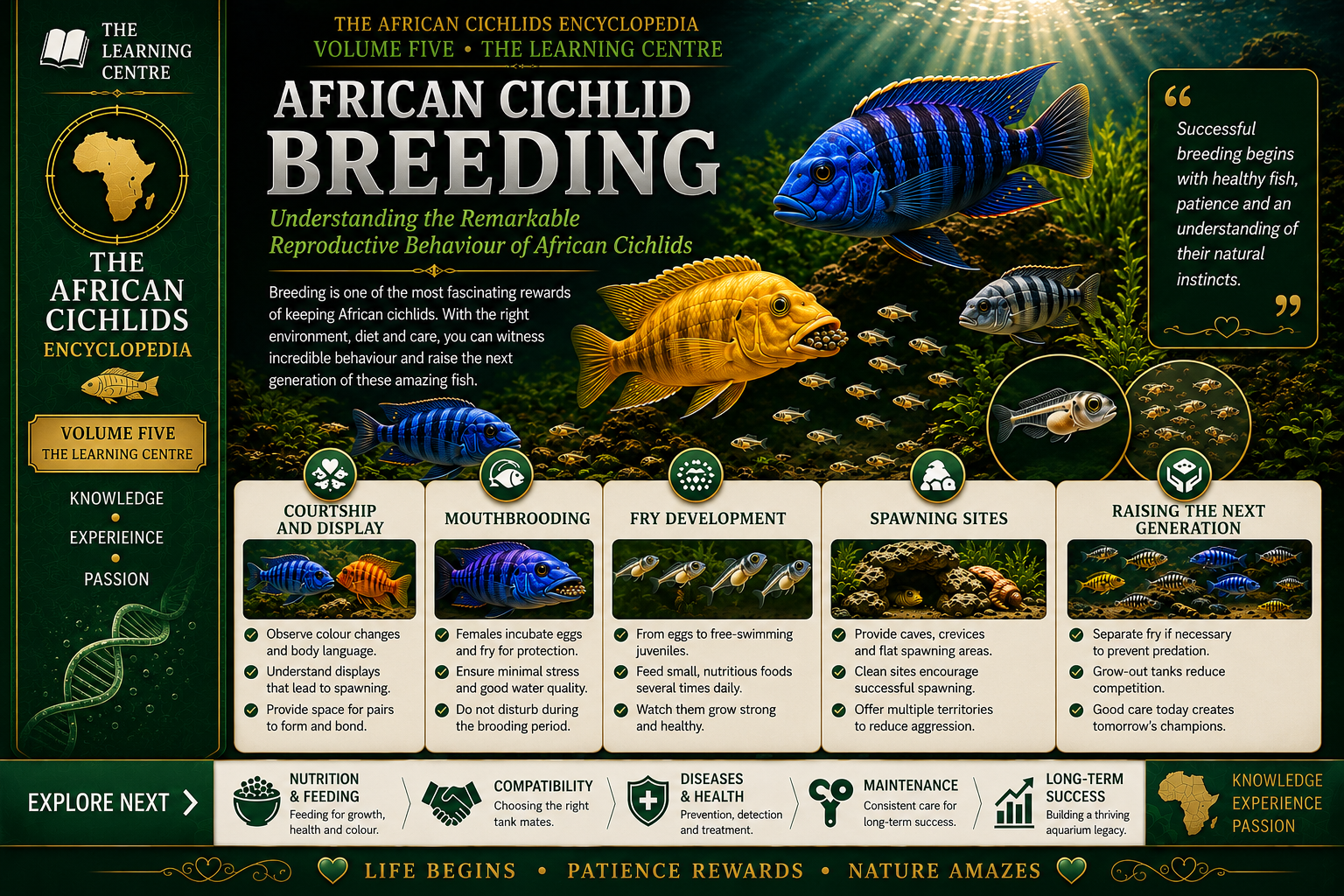
The obvious difference is colour as males have to display this to attract a female when breeding but again it is possible to have very colourful females so in the end if they breed you have a pair. Malawi Cichlids are one of the easiest cichlids to breed and once they do you might find you have more young than you accounted for. The secret to their success is the females, they not only incubate and carry the eggs in their mouths but once hatched will carry and protect their young fry too. This is why they are sometimes referred to as mouthbrooders.
Breeding starts with the male who will aggressively chase the female but this is not to hurt her, this is to get in front of her and show off his colours. He shows of his colours which is also known as his breeding dress by shaking himself in front of her and displaying all his fins in the hope that the female likes what she sees. If the female is ready to breed or "Ripe" which is another name for it, then and only then shall she breed. If she is not ready then she will just ignore the male which is when some males turn aggressive towards the unwilling female.
By this time the male will have established his own territory in which he will have chosen a cave. Once this cave is chosen he prepares it for the female by moving any debris and digging it out to make a suitable breeding surface. The larger open swimming Haplochromis genus do not use caves to breed in so the males will dig a pit in the sandy substrate for the female but the rest of the breeding process is the same as Mbuna.
If the male is successful in winning the female over then she will follow him back to his cave where breeding will begin. If she disapproves of his newly prepared cave then the male will have to find an alternative breeding place for them. Once happy with their chosen place you will see the couple circling round each other and shaking. This display is to encourage the female to start depositing her eggs.
There are now two ways in which these eggs can be fertilised. Which way depends on the individual species and the threat from the other fish in the tank. The first way is when the female drops a few of her eggs the male will swim over them releasing his sperm and then the female will collect these fertilised eggs up in to her mouth then proceed to drop a few more. The second way is when the female drops some of her eggs she will pick them straight up in her mouth but sees the dummy eggs spots on the males anal fin as mention at the beginning. She will then nibble at these markings thinking they are some of her eggs and try to pick them up into her mouth but by doing so this encourages the male to release his sperm which goes straight into her mouth along with the eggs that she had already collected so fertilisation takes place in the mouth.
After breeding the female will leave his cave with her mouth full of eggs and try to find somewhere safe to hide. If you want to keep these young then this is the time to catch the female and put her in a tank on her own. You have to be very careful when netting her as some first time mums and even experienced mums will spit out their eggs when they feel threatened.
If this happens then carry on and place her in the separate tank and quickly collect up any eggs that you can see and place them in the tank and leave her. Sometimes females will pick them back up, other times they ignore or even eat them. It is possible to hatch the eggs yourself. I have had success in doing this by putting the eggs in a net with a small stone in the bottom to stop it floating and placing an airstone underneath the net. The movement from the bubbling water mimics the way the mother would turn her eggs over in her mouth. If you are lucky to hatch the Malawi cichlid fry you can feed them on Liquid Fry or a similar egg layers baby food until they are big enough to take crushed flake food.
If the female is still carrying her eggs then normal incubation lasts around three weeks in which time she may or may not eat, this is normal as I have had females that do and females that don't. She will let her young out only when she feels that it is safe to do so but will quickly gather them up when she feels threatened. When she can no longer hold her young in her mouth she will then be forced to spit them out but will still try to collect them back up when she sees one.
This is when you can catch her and put her back in your main tank making sure her mouth is empty first. You can do this by placing small rocks in the tank so that her young can hide and she can not get them.
Malawi Cichlid Fry
I refer to a female fish with eggs or fry as "Holding" but they are also known as "Carrying". If you are planning on keeping Malawi Cichlids or already do then as long as you have a male and a female you are guaranteed to have fry at some stage. Malawi cichlids will breed readily and easily so make sure that if you want to keep and raise the fry you have enough tanks at hand. It takes about three months for the average fry batch to become near sell-able and once a female has released her fry she can start on the next batch just days after being placed back with her male.
If you do not want to keep the fry then you are best keeping all males. The holding female can be left in the tank to release her batch of fry however these will be eaten by the other fish. This is not something that I personally like to do so if a holding female can be removed with her eggs then I will always try to do so. If you are planning to keep and raise the fry then remove the holding female into her own tank as soon as possible.
Malawi Cichlid fry are fascinating to watch. If you have ever had a holding female in a tank you can sometimes catch the little eyes staring at you when she opens her mouth. Around three weeks later when the fry get to big to hold, the female will release them if she does not feel threatened by anything. If you are lucky you can sometimes catch her doing so or even see them rushing back into their mum`s protective mouth.
At some stage she will not accept the fry back into her mouth at which point you can catch her and put her back in the main tank. If you want to speed up this process then place small bits of rock or slate into the tank for the fry to hide in. This will stop them going back into mum`s mouth. Once the female has been removed then it is down to you to care for the fry.
There are many fry foods available on the market however these can be expensive so all I do is crush some of the adults flake food into powder and feed them a pinch twice a day. The fry will grow very quick at which stage you can introduce tablet food that sticks to the tank or feed them grindal worms which is what I do, as well as larger crushed flake food. In time they will get big enough to eat un-crushed food. When the fry are small it is very entertaining watching them swim round with a whole worm sticking out of their mouth which is bigger than them.
In one of my fry tanks I use the smallest Eheim 2006 internal filter, if the fry do manage to get sucked up they live in the bottom of the sponge chamber with no harm done until I remove them. However you must clean your filter in a container just in case any fry are in their. I also use sponge filters powered by air pumps, these are much safer for the fry however I find that they do not keep the tanks as clean as mechanical filters.
I also have air lines powered by an air pump going into each fry tank. As the fry get bigger I sometimes replace the Eheim 2006 or sponge filter with an Eheim 2010 depending on how many I have in the tank at that time. When doing a water change on a tank with very small fry I use a piece of air line to syphon up all the debris and waste food from the bare bottom tanks then do the water changes as described on our site. All of my fry tanks have bare bottoms (no substrate).
After a few weeks and depending on how big the batch was, you may need to separate your young fish into other tanks as they will be growing quite fast and need more room. It usually takes around three months for them to be near sell-able but once they are you can sell them on and start all over again if you have not already done so. Shops will normally take young fish from about two inches in length but this can vary from shop to shop. Other outlets for your fish are Aquarists Classifieds.
The Breeder's Quick-Reference Toolkit
To supplement our breeding logs, here is a practical reference checklist for managing mouthbrooding females and maximizing fry survival based on real tank experience:
- The Holding Timeline: Malawi cichlid females will typically hold eggs and developing larvae in their buccal pouch (mouth) for 21 to 28 days depending on water temperature. They will generally refuse food during this entire period, though experienced mothers may occasionally nibble tiny particles of flake.
- The Nursery Tank Method: Rather than manually stripping a female—which can cause immense stress—our preferred method is to move the holding mother to her own quiet nursery tank as soon as possible. Letting mum do her job in a peaceful environment ensures she will naturally release her fully formed, free-swimming fry when she feels completely safe.
- Old-School Egg Tumbling (The DIY Net Trick): If a holding female accidentally drops her eggs early, you don't need fancy, expensive modern tumblers to save them. You can create a brilliant DIY tumbler using a standard corner net mesh. Use a tiny clean stone to weight the center of the net down into a small pocket, and place an airstone directly underneath it. The rising bubbles will create a perfect upward current that gently rolls and turns the eggs, keeping them oxygenated and free from lethal fungus until they hatch.
- First Foods for New Fry: Once the fry are free-swimming, feed them 3 to 4 times a day in tiny amounts. The absolute best starting foods are freshly hatched baby brine shrimp (Artemia), finely crushed spirulina flakes, and high-protein powdered fry foods to ensure rapid, healthy structural growth.
- The Hybridization Trap: To maintain genetic purity, avoid keeping multiple species from the same genus that feature similarly colored females (such as different variations of Metriaclima or Pseudotropheus) in the same tank. Malawi cichlids cross-breed incredibly easily, resulting in hybrid fry.