Victorian Cichlids
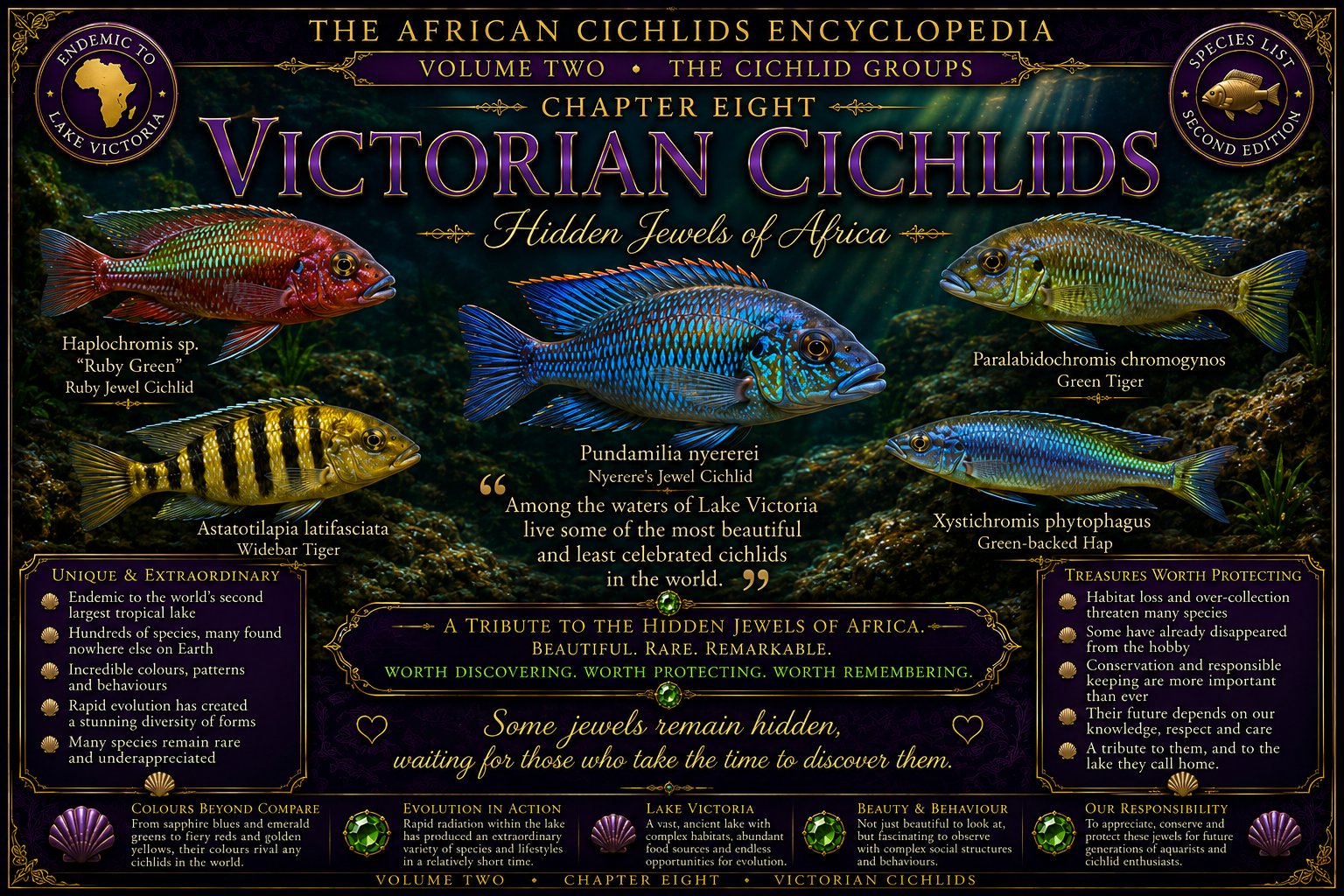
Victorian Cichlids: The Fire-Born Survivors
Welcome to the Victorian Cichlid section (focusing on the true Haplochromines of Lake Victoria). While Lake Malawi has raw variety and Lake Tanganyika has bizarre body shapes, Lake Victoria holds the crown for the absolute fastest vertebrate evolution ever recorded on Earth.
Explore Page → The Plight of the Victorian Cichlids - To look at a brightly coloured Victorian cichlid in a home aquarium is to look at a living ghost. Over the course of just a few decades, Lake Victoria transformed from the planet's most vibrant evolutionary cradle into an ecological warning story.
For a hobbyist doing a total site makeover, this page represents a heroic conservation story. The fish here are intensely colourful, incredibly active, and rely heavily on dedicated home breeders to keep their lineages alive.
What Makes a Cichlid a "Victorian"?
Because Lake Victoria is relatively shallow, turbid, and green-tinted compared to the crystal-clear rift lakes, its fish evolved a completely unique set of physical traits:
- Intense Neon Light Evolution: To see each other through the murky water, dominant male Victorian cichlids developed blazing, high-contrast neon coloration—featuring true glowing reds, bright emerald greens, and deep golds that look almost artificial.
- The Haplochromine Lineage: Unlike Malawi Haps, which are often giant open-water predators, Victorian Haps are compact, fast-swimming rock and sand dwellers. They are incredibly reactive, high-energy fish.
- Fierce Parental Focus: Virtually all Victorian species are tightly synchronized maternal mouthbrooders. Because the lake contains massive native predators, females have evolved highly protective instincts, fiercely guarding their fry long after releasing them.
The Big Changes: Modern Conservation Care
The CARES Preservation Program: Many Victorian cichlids are now officially classified as Extinct in the Wild or Critically Endangered. Home hobbyists are no longer just keeping these fish for fun; they are participating in global registry programs (like CARES) to maintain pure genetic arcs.
Aggression Management: Victorian males are notoriously aggressive toward their own kind. Modern care states they should be kept in large colonies with a high ratio of females to males (ideally 1 male to 3 or 4 females) to safely distribute breeding pressure.
Insect and Detritus Diets: In the wild, many of these species are specialized insect-larva hunters or snail-crushers. In the aquarium, they thrive on high-quality krill or insect-meal flakes, which helps keep their blazing red and orange pigments fully saturated.
Popular Lake Victoria Cichlid Species
Flameback Cichlid (Pundamilia nyererei)
The most iconic Victorian cichlid. Dominant alpha males flash a blazing, brilliant crimson-red across their entire back and dorsal area, sharply contrasted against a bright neon-yellow flank and black belly.
Zebra Obliquidens (Haplochromis latifasciatus)
An absolute hobbyist treasure. Features bold, vertical black and cream bars like a zebra, but mature males develop a striking patch of glowing fire-orange and canary-yellow right on their chests.
Ruby Green (Haplochromis sp. "Ruby Green")
One of the most peaceful Victorian species. They are active sand and plant foragers where dominant males display a beautiful, shimmering mix of metallic emerald-green and deep ruby-red flanks.
Victorian Zebra (Haplochromis "Kyoga Flameback")
Native to Victoria's satellite lake system. They are famous for an extremely high-contrast dark bar system running over a brilliant chartreuse-green base, highlighted by a solid neon crimson forehead.