Tropheus
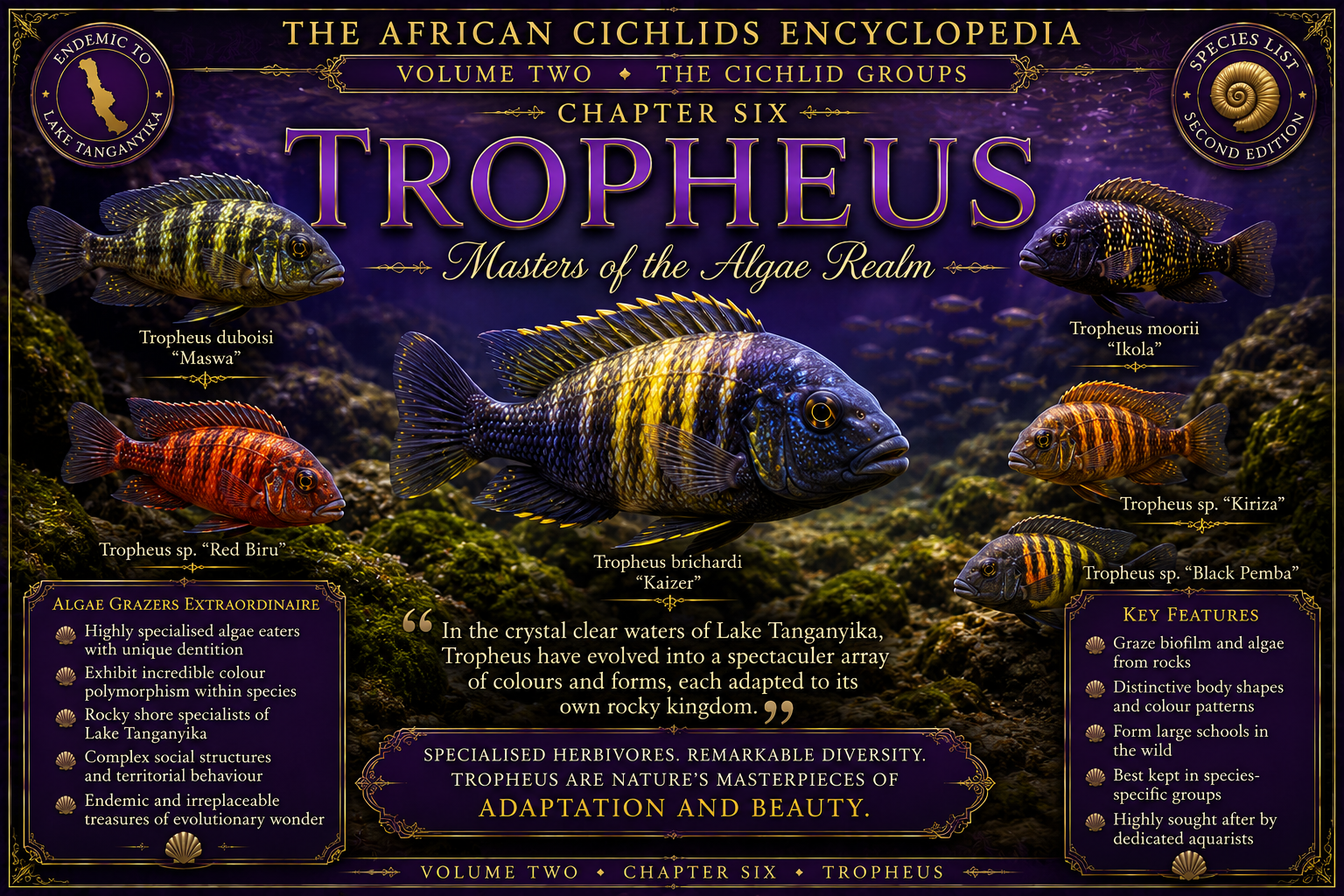
The Tropheus family is the absolute royalty of Lake Tanganyika rock-dwellers.
They are the high-octane, hyper-energetic equivalents of Lake Malawi’s Mbuna.
Because they live in complex, tightly-knit social communities, they require a unique approach to aquarium keeping. In fact, many hobbyists consider successfully keeping a breeding colony of Tropheus to be one of the ultimate badges of honour in the African cichlid world.
What Makes a Cichlid a "Tropheus"?
Tropheus species occupy the shallow, wave-battered rocky reefs of Lake Tanganyika where the sunlight is most intense, creating thick carpets of green algae on the stone faces.
- The Marine Surgeonfish Mimics: Tropheus have evolved a compact, blunt head structure with downward-sloping mouths and chisel-like teeth. They look and behave almost exactly like marine Surgeonfish or tangs, grazing on algae mats (Aufwuchs) all day long.
- The Colony Bond: Tropheus do not live as independent pairs. They function within a strict, highly aggressive social hierarchy or "colony." The alpha male dominates the group, and the rest of the colony establishes a complex pecking order underneath him.
- Vibrant Colour Morphs: Tropheus are famous for their geographic variations. Because they refuse to cross wide patches of deep sand, colonies isolated at different rocky points around the lake have evolved completely distinct colour patterns—ranging from bright cherry reds to neon yellows and rainbows.
tuyu
The Tropheus Care Guide: Mandatory Rules
If you ever decide to expand your fish room beyond your upcoming Shell Dweller project, Tropheus require a very specific, strict setup:
- The Colony Number Rule (Crucial): You should never keep just a pair or a small group of Tropheus. To successfully keep them, you must purchase a minimum colony of 15 to 20+ fish of the exact same species at the same time. This high number safely dilutes the intense territorial aggression of the alpha male across the entire group.
- The "Tropheus Bloat" Danger: Like Mbuna, Tropheus have incredibly long, delicate digestive tracts designed entirely for processing tough plant matter. Feeding them high-protein foods like bloodworms or beef heart is a death sentence. They require a strict, exclusive diet of premium Spirulina flakes or kelp pellets.
- Zero Layout Changes: Once a Tropheus colony establishes its pecking order in an aquarium, you should never rearrange the rockwork or add a new fish to the tank. Altering the layout resets their territories, causing violent battles as they re-fight to establish a new hierarchy.
Popular Lake Tanganyika Tropheus Variants
Bemba Orange Flame (Tropheus moorii "Bemba")
One of the most striking variants. Features a rich, solid jet-black body split directly down the middle by a wide, blazing neon-orange vertical band.
White Band Duboisi (Tropheus duboisi)
Famous for their incredible pattern shift. Juveniles are solid black covered in glittering white stars. Adults change to a blue head with a stark white vertical mid-body stripe.
Ikola Kaiser (Tropheus moorii "Ikola")
Highly sought after by collectors. Boasts a pitch-black head and tail frame broken up by a massive, solid bright canary-yellow saddle that blankets the entire midsection.
Bulu Point Cherry Spot (Tropheus sp. "Black")
An absolute showstopper. Features a deep, velvety charcoal black body heavily decorated with twin patches of brilliant, glowing cherry-red spots across the upper back flanks.