Fish Behaviour
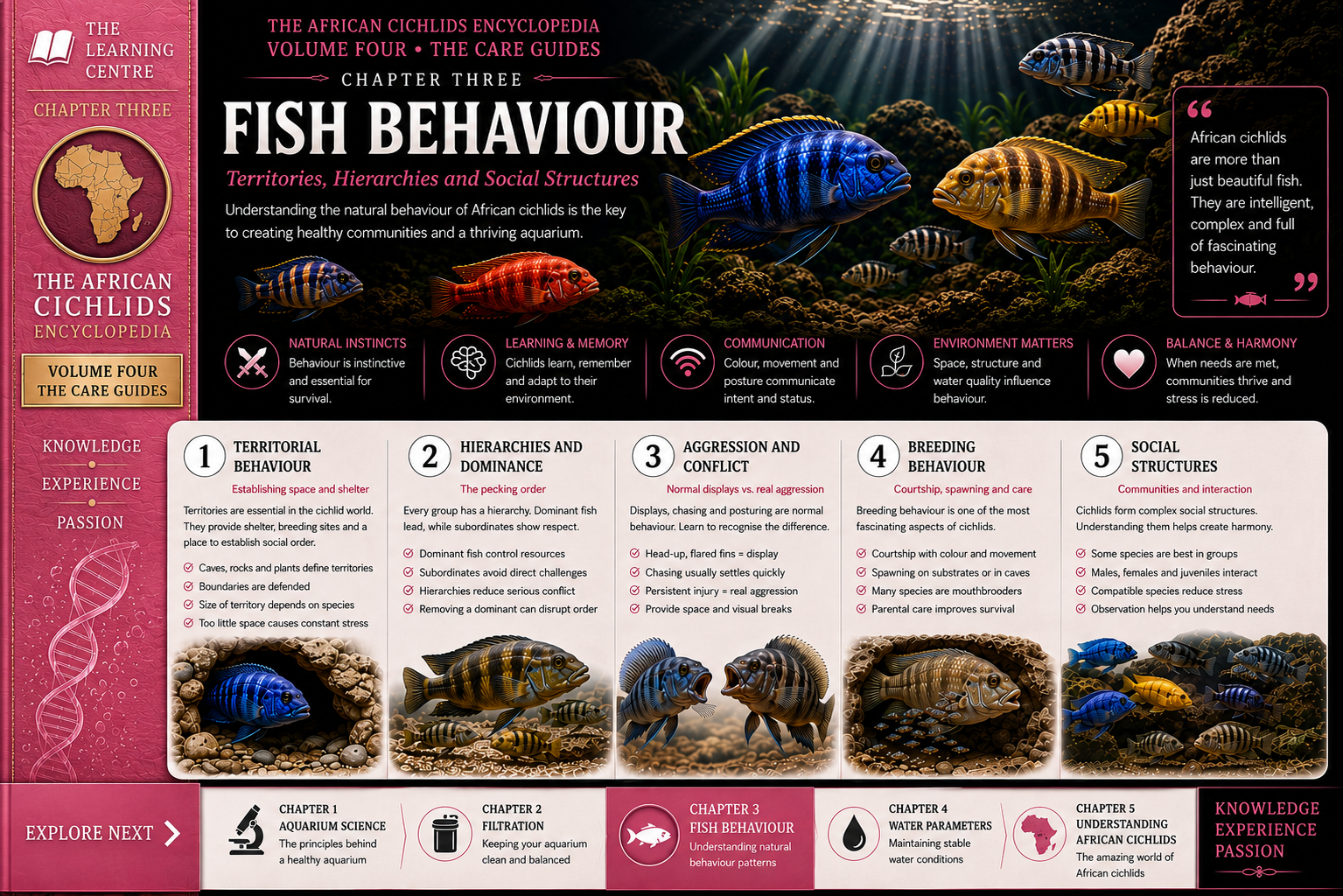
25 Years of Experience: Decoding the Malawi Social Hierarchies
To successfully keep Lake Malawi cichlids, you must become part fishkeeper and part animal psychologist. Over the past twenty-five years, I have watched thousands of hours of cichlid interactions. Their actions are never random. Every single twitch of a fin, shift in colour, and aggressive chase is a calculated response to their social environment. By understanding the evolutionary programming behind their complex territorial structures, dominance displays, and breeding rituals, you can accurately predict and manage their behavior before it turns destructive.
"The secret to managing Lake Malawi cichlid aggression is understanding that it cannot be entirely eliminated—it can only be directed and diluted. They are genetically wired to compete for status and space. Once you decode their body language and social rules, you can spot a rising tyrant or a stressed subdominant fish days before an injury occurs."
1. Territorialism and the Alpha Hierarchy
In the wild, a prime piece of rock or an open-water breeding territory means survival and mating rights. In the home aquarium, this instinct remains entirely intact. A typical Malawi tank establishes a strict, rigid pyramid hierarchy:
- The Alpha Male: The undisputed king of the aquarium. The alpha male displays the most vibrant, electric coloration, claims the largest and best cave (or the center of the open water), and commands the tank. He will constantly patrol his borders, keeping all rivals at bay.
- Subdominant Males: These are the "beta" and "gamma" males. To avoid being systematically killed by the alpha, subdominant males possess an incredible survival mechanism: they can completely dull their colors to mimic females. If you see a fish suddenly 'colour down' and turn a drab gray or brown, it is intentionally trying to fly under the alpha's radar.
- Hyper-Aggression vs. Ritual Displays: True aggression involves physical damage, such as lip-locking (a test of physical strength), tail-beating, and raw fin-nipping. Most interactions, however, are ritual displays—like lateral flares (showing off maximum body profile) or rapid shimmying—designed to assert dominance without risking a deadly physical injury.
2. The Complex Dynamics of Courtship and Breeding
Lake Malawi cichlids are famous for their unique reproductive strategy: maternal mouthbrooding. The breeding cycle is a beautiful yet intense process that significantly shifts the entire tank's behavioral dynamic:
- The Mating Dance (The T-Position): When a male is ready to spawn, his colors intensify to an almost blinding level. He will violently shimmy his body and display his bright egg-spots (the round, colorful spots on his anal fin) to lure a female to his territory. They will circle each other rapidly, forming a 'T' shape. The female drops her eggs, instantly turns around to scoop them into her mouth, and snaps at the male’s anal fin egg-spots—tricking her into taking in his milt to fertilize the eggs safely inside her mouth.
- The Brooding Female: Once the eggs are fertilized, the female becomes a "holding" or brooding mother. She will carry the eggs, and eventual free-swimming fry, securely inside her buccal cavity (throat pouch) for 21 to 28 days. During this month-long period, she will refuse all food. You can easily spot a holding female by her distended, dropped "double chin" and her defensive, reclusive behavior.
- Conserving Maternal Energy: Because she is starving while protecting her young, a holding female is physically weak and highly vulnerable to being bullied. Providing deep, tight crevices where big males cannot fit is essential for her survival.
3. Conspecific Aggression and Social Mimicry
One of the most critical rules I have discovered over my 25 years in the hobby is the concept of conspecific aggression—the reality that a fish will save its absolute worst hostility for tankmates that look exactly like it.
- The Target Matrix: An alpha male views any fish with the same color patterns, bars, or body shapes as a direct structural threat to his lineage. For example, a blue-and-black barred male Mbuna will largely ignore a solid yellow species, but will relentlessly hunt another blue-and-black barred fish.
- Stocking Mitigation: To exploit this quirk of psychology, always aim to mix species with vastly different visual aesthetics. Never stock two different species that share identical colour palettes or stripe orientations, as the dominant fish will quickly eliminate the lookalike.
Cichlid Body Language & Behaviour Checklist
Watch your tank during normal resting periods (not during feeding) and check for these behavioral flags to monitor the psychological health of your community.
- [ ] Corner Hovering (Stress Flag): Is a fish hovering vertically at the very top corners of the tank or hiding behind a heater?
→ Diagnosis: This fish has been completely expelled from the rockwork hierarchy by the alpha. It needs immediate visual line-of-sight breaks or isolation before it is physically broken. - [ ] Constant Pit Digging (Nesting Flag): Is a male cichlid frantically excavating massive craters in the sand all the way to the eggcrate?
→ Diagnosis: This is classic nesting behavior. The male is claiming a spawning arena and will become hyper-protective of this specific zone over the next 48 to 72 hours. - [ ] Fin Shivering & Tail Flares (Courtship Flag): Is a highly coloured male rapidly vibrating his body directly in front of a female's face?
→ Diagnosis: This is a harmless, non-violent courtship display. The male is showing off his health and dominance to initiate a breeding dance. No intervention is required.