Substrate Science
25 Years of Experience: The Chemistry and Mechanics of Cichlid Sand
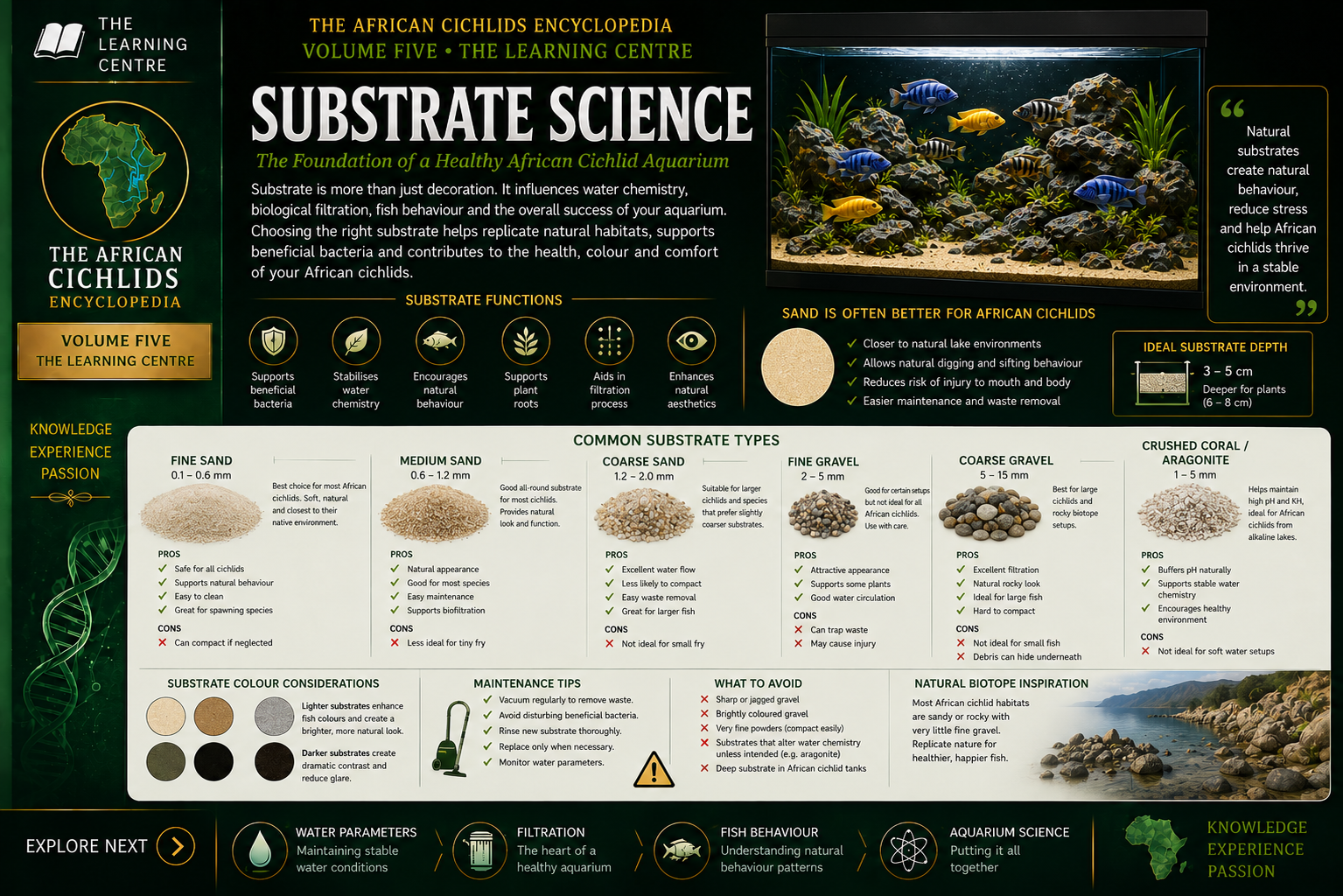
To many casual fishkeepers, substrate is merely a cosmetic backdrop. But in a Lake Malawi aquarium, the substrate functions as a critical chemical buffer and a vital behavioral outlet. Over twenty-five years of running these setups, I have tested almost every substrate material available—from black quartz to crushed glass. My conclusion is definitive: choosing the wrong substrate can drastically increase your maintenance workload, stress your fish, and even lead to severe physical injuries.
"Substrate in a Malawi tank is a working component of your filtration and water chemistry. Because these fish sift, dig, and chew the substrate daily, its texture dictates their physical safety, while its mineral composition acts as an automatic shield against dangerous pH fluctuations."
1. The Chemistry: Active Buffering vs. Inert Substrates
Unlike standard community tanks that utilize inert gravels, a Malawi tank benefits immensely from a chemically active substrate that alters water parameters:
- Aragonite and Crushed Coral (The Active Shield): Aragonite is composed of pure calcium carbonate. When water parameters attempt to drift toward an acidic state (due to heavy fish bioloads), aragonite slowly dissolves, releasing calcium, magnesium, and carbonate ions. This automatically forces your pH to sit stably between 8.0 and 8.4 while supporting high GH and KH.
- Inert Substrates (The High-Maintenance Path): Materials like pool filter sand, black diamond blasting abrasive, or standard quartz sand look nice but offer absolutely zero chemical buffering. If you use them, you are entirely dependent on manual dosing powders to prevent a dangerous pH crash.
2. The Mechanics: Grain Sizing and Physical Safety
Malawi cichlids are natural-born earthmovers. Watching them scoop up mouthfuls of sand and blow it out of their gills or carry it away to build breeding pits is an incredible sight, but it requires the correct texture:
- The Golden Rule: Fine Sand Only: You must always use a fine, smooth sand substrate (grain sizes between 0.5mm and 1.5mm). Gravel or crushed coral chips should be avoided as primary substrates. Large, sharp gravel stones can choke a fish trying to clear a pit or severely scratch their delicate mouthparts and gills during sifting.
- The Gill-Sifting Mechanism: Haps and many Mbuna actively pass sand through their gill rakers to filter out microscopic food particles. If your substrate consists of sharp gravel, this natural behavior is blocked, causing chronic psychological frustration and potential gill damage.
3. Managing the Substrate Bed: The Anaerobic Danger
While sand is highly superior for cichlid health, its tight packing structure creates a specific maintenance challenge known as anaerobic dead zones.
- The Gas Trap: Because sand packs tightly together, water cannot easily circulate through it. If a sand bed is deeper than 5cm, oxygen-depleted (anaerobic) zones will develop beneath the surface. Over time, specialized bacteria in these zones produce highly toxic hydrogen sulfide gas. If a cichlid digs into one of these pockets, the released gas can instantly poison the tank.
- The Depth Remedy: To permanently prevent this, keep your sand depth to a maximum of 3cm to 5cm. During your weekly maintenance water changes, always push your siphon tube deeply into open sand areas to gently stir the bed, ensuring oxygenated water constantly disrupts any emerging anaerobic pockets.
Substrate Safety & Science Checklist
Verify these substrate rules before filling your aquarium to ensure perfect water buffering and a safe digging environment.
- [ ] Acid-Wash Vinegar Test: If you are testing unknown sand for buffering capacity, does it fizz strongly when you drop a few drops of white vinegar onto a dry sample?
→ Scientific Meaning: Fizzing confirms the presence of calcium carbonate, proving the sand will actively buffer your Malawi pH. - [ ] Texture Roundness Check: Is the sand texture advertised as "rounded" or "sub-angular" rather than sharp/crushed silica?
→ Scientific Meaning: Rounded grains glide harmlessly through the mouth and gill rakers without creating micro-tears that invite bacterial infections. - [ ] Debris Stratification Shield: Have you chosen a lighter-colored sand (like ivory or light tan) over ultra-bright white or solid black?
→ Scientific Meaning: Natural tan sand hides minor fish waste beautifully between water changes, whereas stark white sand highlights every speck of detritus, and dark black sand can cause cichlids to naturally darken and dull their vibrant colors to match their background.