Peacock
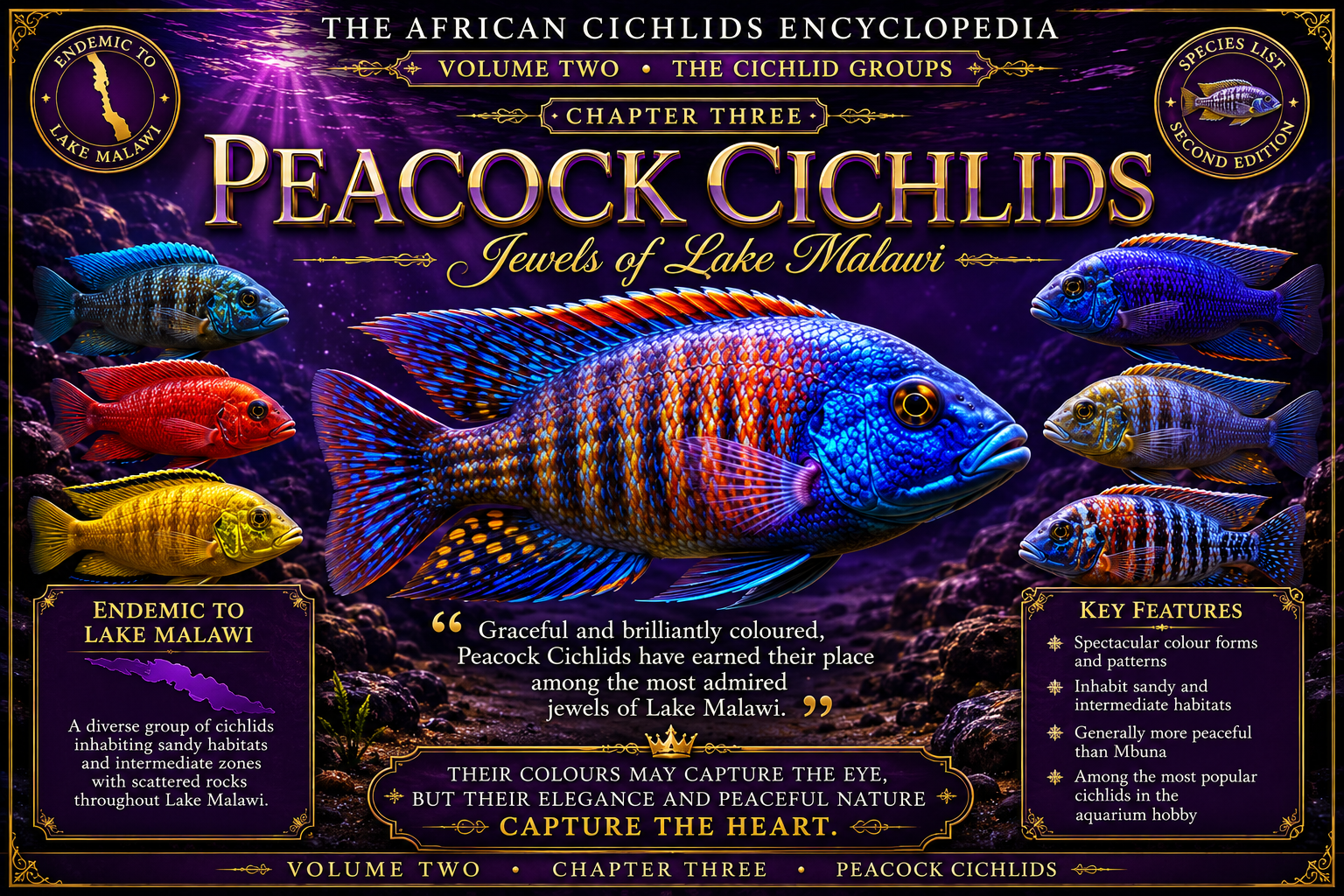
Peacock Cichlids: The Flashing Jewels of the Sand
Peacock Cichlids (belonging strictly to the genus Aulonocara) are widely considered the most magnificent, eye-catching fish in Lake Malawi. While Mbuna dominate the rocks, Peacocks occupy the sandy transition zones where the rocks give way to wide-open desert floors. They earn their name because dominant males display an astonishing array of metallic blues, neon yellows, and ruby reds that rival the feathers of a peacock.
What Makes a Cichlid a "Peacock"?
Peacocks have evolved an entirely different anatomical toolkit compared to rock-scraping Mbuna or open-water predatory Haps.
- Acoustic Sensor Hunting: If you look closely at a Peacock's face, you will notice tiny, pitted sensory pores along their jawline. These pores act like radar. The Peacock hovers perfectly still, millimeters above the sand, listening for the microscopic movements of tiny invertebrates hidden under the substrate. When it hears a sound, it dives face-first into the sand to swallow its meal.
- Extreme Sexual Dimorphism: Unlike many Mbuna, female Peacocks are entirely colourless. They remain a uniform, drab silver-brown with faint dark vertical bands their entire lives. This protects them from predators while mouthbrooding over open sand. Males, however, change into deep iridescent neon colours as soon as they claim a breeding territory.
- Peaceful Demeanour: Peacocks are vastly more peaceful and mild-mannered than Mbuna. They do not fight for rock caves; instead, they establish broad, shifting territorial circles over open sand, making them far easier to manage in a community setting.
Modern Care & Breeding Insights
The Substrate Rule: Because Peacocks naturally sift through the earth for food, crushed coral or fine pool filter sand is mandatory. Fine sand protects their delicate gills and mouths. Rough gravel will scratch them and stop their natural hunting behaviours completely.
The Hybridisation Trap: Peacocks are notorious cross-breeders in home aquaria. If you place a male Peacock with females of a different Peacock species, they will happily hybridise, resulting in mixed-breed fry that degrade the pure lines of the hobby. To prevent this, modern breeders either keep a "Malawi All-Male Show Tank" or breed only one specific Peacock colony per aquarium.
Dietary Boundaries: Unlike Mbuna, Peacocks are carnivores and insectivores. They cannot survive on pure algae flakes. They require high-protein foods like high-quality krill pellets, mysis shrimp, and specialized cichlid granules to maintain their brilliant metallic colours.
Popular Lake Malawi Peacock Species
Eureka Red Peacock (Aulonocara jacobfreibergi "Eureka")
A stunning line-bred variant of the natural Jacobfreibergi. Males develop a deep, blazing ruby-red body accented by ice-blue highlights on the head and dorsal fins.
Sunshine Peacock (Aulonocara baenschi)
Native to Benga Reef. Alpha males display a solid, rich canary-yellow body that contrasts beautifully against a bright metallic neon-blue face and jawline.
Flavescent Peacock (Aulonocara stuartgranti)
A geographical variant from Usisya. Noted for a highly iridescent electric-blue frame mixed with a warm, golden-yellow midsection and deep blue throat.
Blue Orchid Peacock (Aulonocara kandeense)
A highly elegant, dark-colored Peacock from Kande Island. Unlike brighter variants, it displays a deep midnight-blue body topped by a striking white dorsal fin edge.