New Keepers Journal
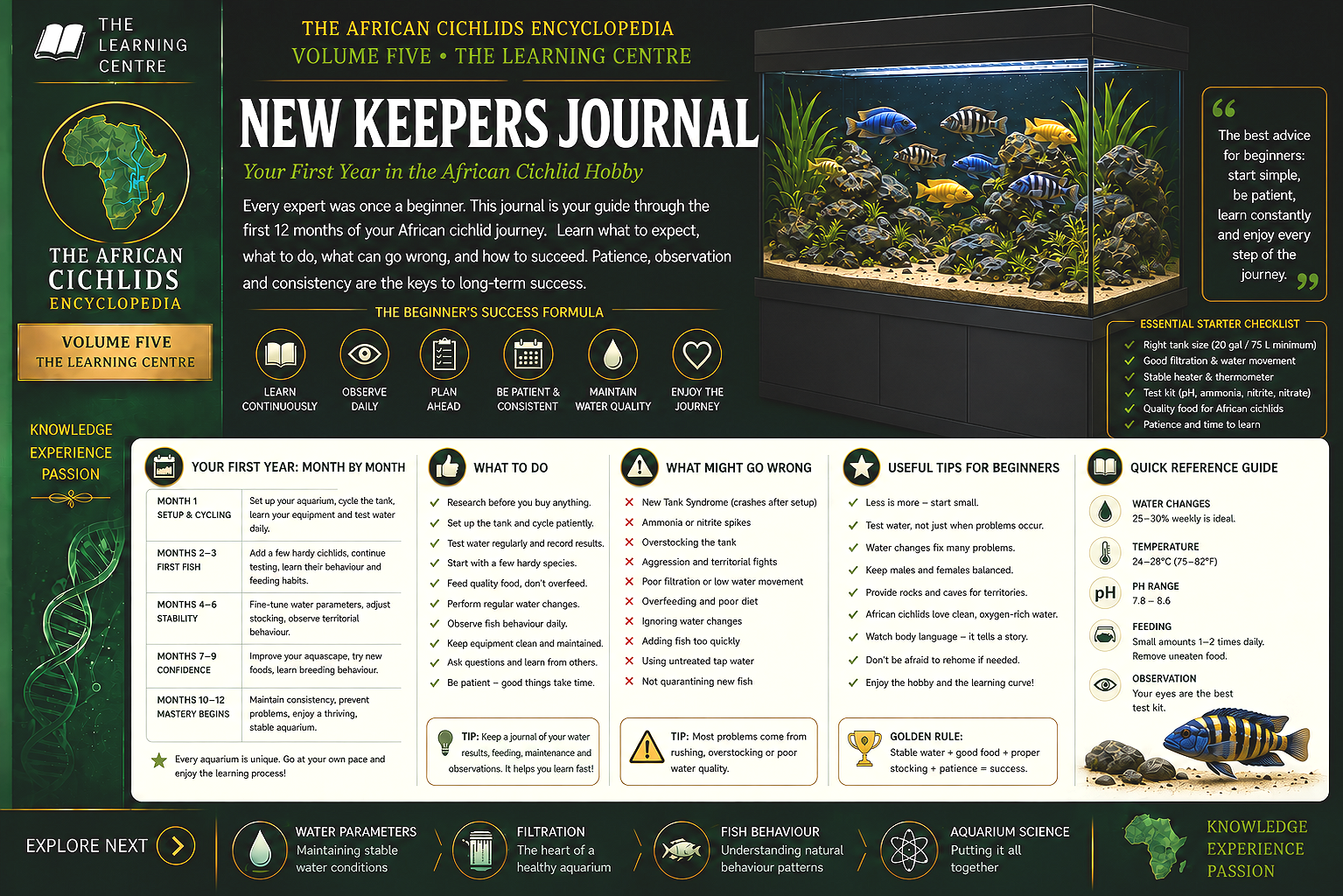
25 Years of Retrospect: The 12-Month Chronology of a Malawi Tank
When starting your first Lake Malawi aquarium, the sheer volume of technical information can feel overwhelming. You read about water chemistry parameters, filtration turnover rates, and complex evolutionary groups, but it can be difficult to visualize how a tank actually matures over time. Based on my twenty-five years of starting up new environments, I have compiled this chronological 'New Keepers Journal'. This timeline maps out exactly what you will experience, what milestones to celebrate, and what hurdles to avoid during your first year.
"In the Learning Centre, we bring science down to earth. A Lake Malawi aquarium is not static; it passes through highly predictable developmental stages over its first year. If you know exactly when the brown algae will hit, when the first territorial battles will begin, and when the colony will stabilize, you can navigate your first twelve months with zero panic."
Month 1: The Invisible Setup and The Diatom Shadow
The first four weeks are all about patience, biology, and fighting the urge to rush. This is where your biochemical engine is built.
- What is Happening: You have added your eggcrates, stacked your heavy rocks, and poured in your aragonite sand. Your primary goal this month is establishing your nitrogen cycle using a reliable ammonia source or robust seed bacteria.
- The Hurdle (The Brown Phase): Around week three, a dusty, brown film will likely coat your sand and rocks. Do not panic! This is the standard Brown Diatom Algae phase. It feeds on the silicates leaching from your new glass and sand. It is entirely harmless and will naturally burn itself out as your water parameters balance.
Months 2 to 3: The Juvenile Honeymoon and The First Fry
You have introduced your unsexed, juvenile cichlids (typically 4–5 cm in size). At this stage, the tank feels peaceful and harmonious.
- What is Happening: Your young fish are exploring the rock fortresses and sifting sand. Because they are sexually immature, their colors are subtle, and true aggression is virtually non-existent. You will feel like you have mastered the hobby.
- The Milestone (The Surprising Dance): Toward the end of month three, you may notice a couple of fast-growing fish starting to engage in rapid, circular dances. Do not be surprised if a female suddenly stops eating and develops a 'double chin'—Lake Malawi cichlids breed at remarkably young ages, and your first maternal mouthbrooding event often happens during this honeymoon phase.
Months 4 to 6: The Teenage Riot and Color Transformation
Welcome to the most challenging, chaotic phase of your cichlid journal. This is the period that tests your setup architecture.
- What is Happening: Your fish are hitting puberty. Hormones are surging, and alpha males are beginning to claim permanent ownership of specific rock piles. Drab, gray juvenile fish will suddenly transform overnight into electric blues, vibrant yellows, or deep oranges.
- The Hurdle (Managing the Bully): This is when a poorly planned harem ratio or a lack of rock sight-breaks will cause major stress. You will notice subdominant fish being chased to the upper corners of the glass. This is the exact window where your 10x filtration turnover and strict water maintenance routine protect your fish from stress-induced illnesses like Malawi Bloat.
Months 7 to 12: The Established Empire
By the end of your first year, your aquarium transitions from a chaotic teenage riot into a structured, highly predictable aquatic empire.
- What is Happening: The social hierarchy is firmly locked in. Your alpha males are fully colored and magnificent, your subdominant fish have learned to 'colour down' to safely blend into the background, and breeding cycles occur with clockwork regularity.
- The Reward: Your rock fortresses are now covered in a beautiful, natural blanket of green turf algae, providing a constant foraging outlet that keeps aggression down. Your weekly maintenance routine has become second nature, and your ecosystem is completely stable.
New Keeper Milestones Checklist
Track your progress through your first year by checking off these vital ecological and behavioral turning points.
- [ ] The Diatom Shift (Month 1-2): Has your dusty brown film successfully given way to clean rock surfaces or green spots?
→ Sign of Success: Confirms silicates have depleted and your lighting photoperiod is successfully transitioning toward healthy green turf growth. - [ ] The Alpha Coronation (Month 4-6): Have you confidently identified your tank's primary alpha male based on his dominant coloration and cave ownership?
→ Sign of Success: Your tank is successfully building its natural social pyramid. Keep a close eye on your harem numbers to ensure his attention is properly diluted. - [ ] The Peristalsis Equilibrium (Month 9-12): Have your fish gone a full six months with zero signs of flashing, clamped fins, or bloat symptoms?
→ Sign of Success: You have completely mastered water science and dietary parameters, establishing a robust biological environment.