Aquarium Science
25 Years of Experience: The Biological Engine of a Malawi Tank
To the untrained eye, an aquarium is simply a glass box filled with water, fish, and rocks. But beneath the surface lies a complex, invisible biochemical engine. In my twenty-five years of fishkeeping, I have learned that long-term success has very little to do with luck and everything to do with understanding microbiology. Because Lake Malawi setups are heavily stocked to curb territorial aggression, the biological load is intense. If you do not understand the science of how your water processes waste, the ecosystem will collapse rapidly.
"The single most important concept any fishkeeper can master is that we don't actually keep fish—we keep bacteria. The fish are simply the beneficiaries of a healthy, thriving microbiological colony. If you look after your beneficial bacteria, your water science will look after your cichlids."
The Nitrogen Cycle: Deconstructing the Waste Factory
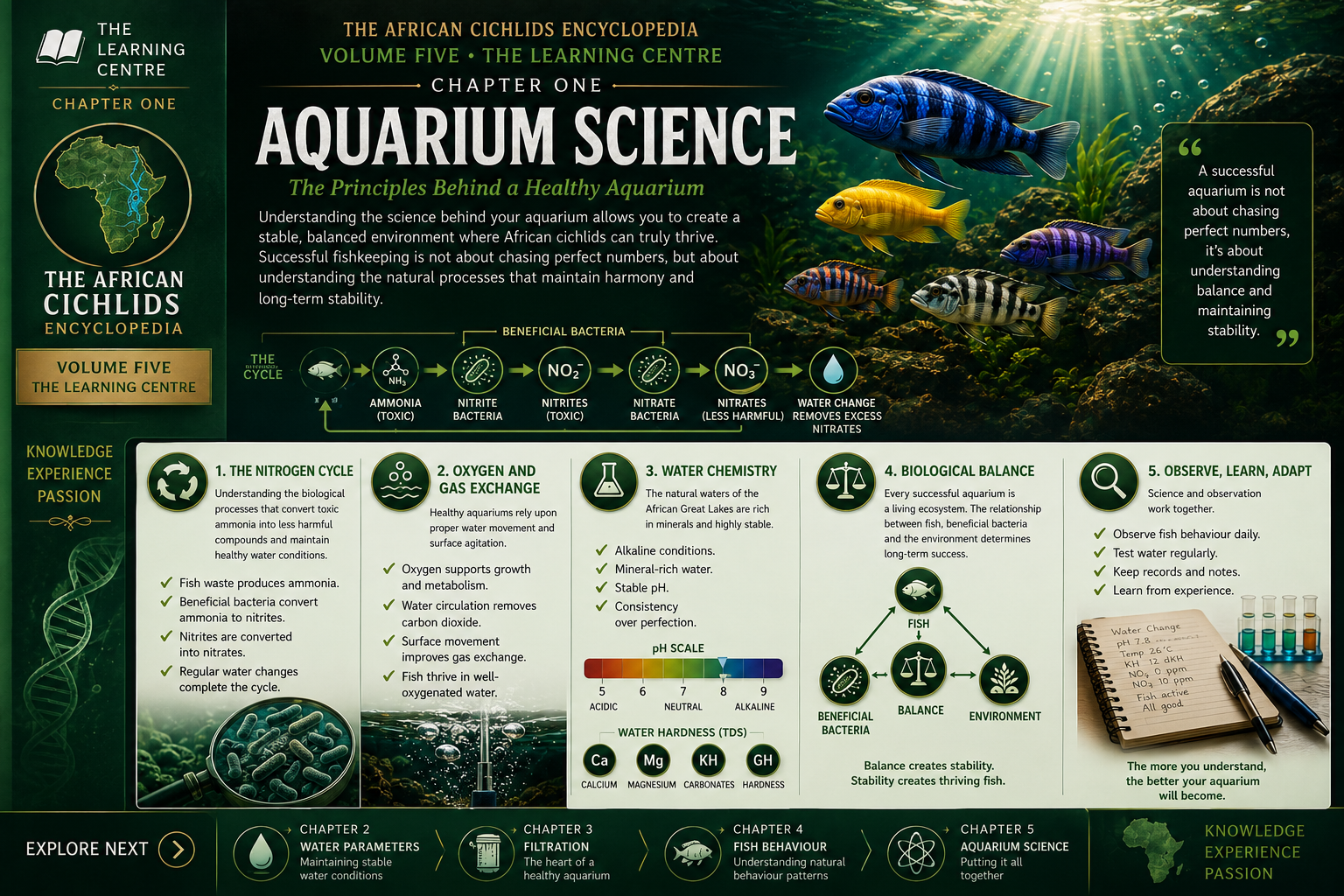
Every living organism in your tank produces waste. In a high-energy Malawi community, this biological waste production is magnified. The Nitrogen Cycle is the multi-stage biochemical process that converts highly toxic fish waste into completely manageable compounds:
- Stage 1: Ammonia (NH3/NH4+) – The Deadly Start: Fish release ammonia constantly through their respiration (gills) and their solid waste as it breaks down. Ammonia is highly toxic. In a hard, alkaline Malawi tank (pH above 8.0), ammonia shifts chemically into its most lethal, un-ionized form. Even tiny traces (0.25 ppm) can burn gills, cause neurological damage, and kill your cichlids within hours.
- Stage 2: Nitrite (NO2-) – The Suffocator: A specialized group of beneficial oxygen-loving bacteria (primarily Nitrosomonas) colonizes your filter media and consumes the ammonia, converting it into Nitrite. While an improvement, Nitrite is still incredibly toxic. It enters the bloodstream of your cichlids and binds to their hemoglobin, preventing their blood from carrying oxygen. A fish suffering from nitrite poisoning will hover near the surface, gasping for air even if the water is highly oxygenated.
- Stage 3: Nitrate (NO3-) – The Final Accumulation: A second colony of beneficial bacteria (primarily Nitrobacter or Nitrospira) quickly consumes the nitrite and converts it into Nitrate. Nitrate is vastly less toxic and is tolerated well by cichlids in low concentrations. However, it does not disappear on its own; it continually builds up in the water column until you physically remove it via your weekly water changes.
The High-pH Multiplier: Why Cichlid Science is Different
Many general aquarium guides state that low levels of ammonia are acceptable during a tank cycle. This is a critical error for a Lake Malawi setup. The toxicity of ammonia is directly tied to your water temperature and pH:
- The Chemical Shift: In an acidic tank (pH 6.5), ammonia converts into non-toxic ammonium (NH4+). But in your properly buffered Malawi tank with a pH of 8.2, that exact same concentration remains pure, highly toxic free ammonia (NH3).
- The Zero-Tolerance Rule: Because of this high-alkalinity multiplier, your biological filtration must be robust enough to maintain absolute, unyielding zeroes for both Ammonia and Nitrite at all times. There is no safe margin for error.
The pH/KH Relationship: Preventing the Acid Crash
As your beneficial bacteria process intense loads of ammonia and nitrite, they consume vast amounts of carbonates from the water column as a fuel source. This process releases hydrogen ions, which naturally drives the pH downward.
- The Buffer Shield: This is why your Carbonate Hardness (KH) is so vital in aquarium science. If your KH is too low, the biological filter will rapidly deplete all available carbonates. Once they are gone, your pH will plummet from 8.2 down to 6.0 overnight.
- Filter Stagnation: This sudden drop is known as an "acid crash." Not only does it shock and kill your cichlids, but beneficial nitrifying bacteria go dormant and stop functioning when the pH drops below 6.5, completely breaking your nitrogen cycle and causing a secondary ammonia spike. Maintain a high KH (10–14 dKH) to guarantee your biological filter never runs out of fuel.
Aquarium Science Diagnostic Checklist
When testing your water with liquid test kits, use this checklist to instantly interpret what your chemical parameters are telling you about your filter health.
- [ ] Ammonia > 0 ppm: Your biological filter is experiencing a bottleneck or has crashed.
→ Direct Action: Immediately halt feeding, perform a 50% water change, dose with a water conditioner that detoxifies ammonia, and verify no dead fish are hidden in the rocks. - [ ] Nitrite > 0 ppm: The secondary bacterial colony is struggling to keep pace with the waste load.
→ Direct Action: Add a dose of aquarium salt (1 tablespoon per 20 litres) to prevent the nitrite from entering the fish's bloodstream, and maximize surface agitation to increase dissolved oxygen. - [ ] Nitrate > 40 ppm: Your water changes are not keeping pace with the biological waste production of the tank.
→ Direct Action: Increase the volume or frequency of your weekly water changes, thoroughly vacuum the substrate, and blast trapped organic detritus out from inside your rockwork tunnels.