Maintenance
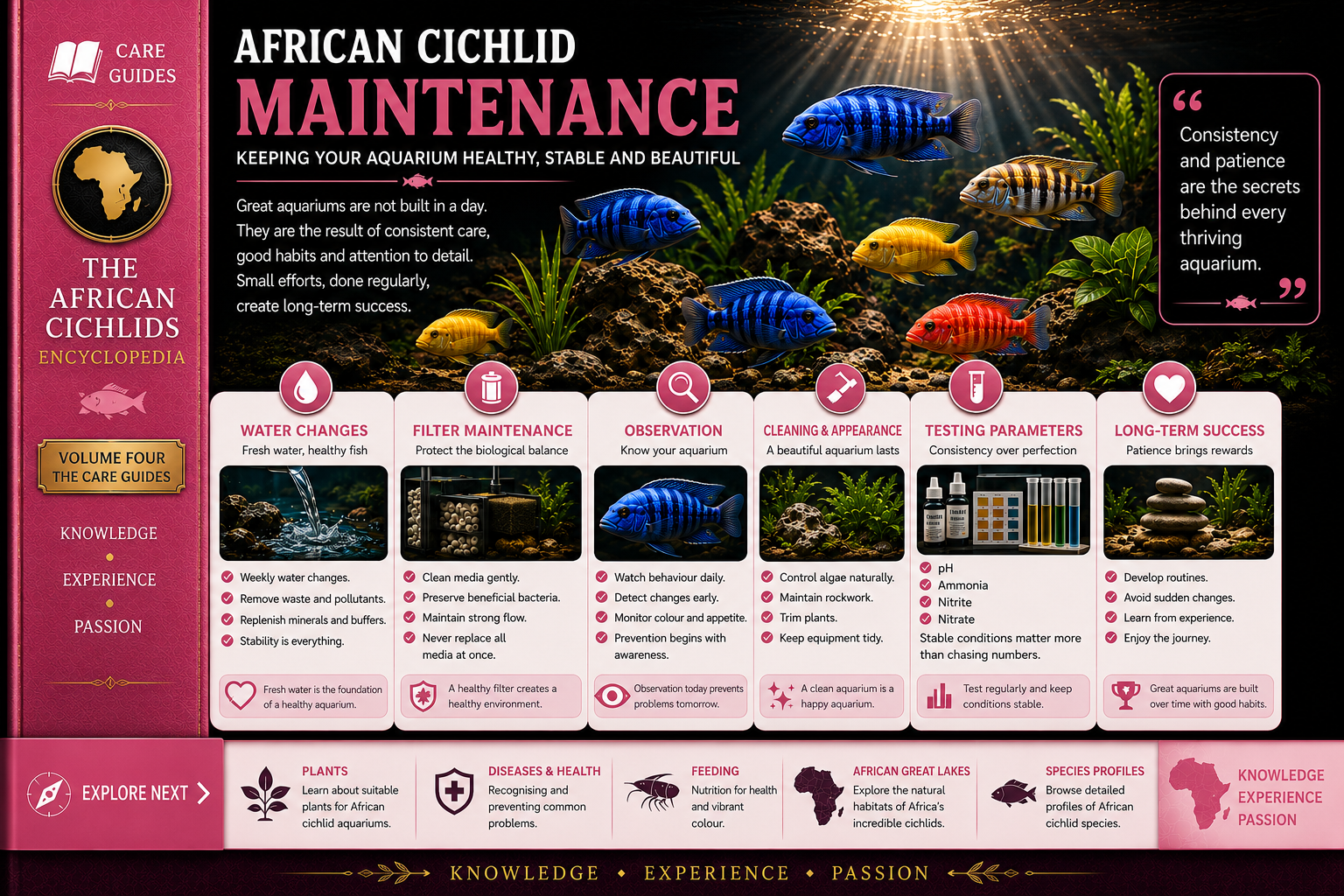
African Cichlid Maintenance → Water Changes written by Malawi Cichlids
Written content © Copyright Malawi Cichlids (African Rifts)
Doing water changes on your tank is very important if you want to keep your fish healthy and the smaller the tank the more often you need to do them. When I was running my 84" x 24" x 18" and other large fish Tanks I did the main water change every four weeks replacing around a quarter to a third of the water but in-between water changes I sometimes replaced a few gallons due to uneaten food or warm weather.
I always use an electronic PH Monitor so that I can keep an eye on the PH levels. Small tanks, example 18" x 12" x 12", get a quarter to a third of the water changed weekly. All of my water changes are done using a gravel cleaner so that I can syphon up any debris and waste food from the substrate. A gravel cleaner also comes in handy for 'banking up' the gravel towards the back of the tank. This helps in moving any debris and waste down to the front of the tank making cleaning a little easier.
The water is always treated with T.A.P water conditioner which removes chlorine and detoxify heavy metals from the tap water. When you do a water change make sure that the bucket you use is only intended for that job and has not been used for anything else. Another handy tool to have if you use power-heads or internal filters is a toothbrush, they are excellent for cleaning out any debris that has got trapped and are very inexpensive but remember to use one that has not been used for anything else.
I currently use CaribSea Eco-Complete African Cichlid substrate to help buffer the water as commercial water treatments and buffers such as cichlid chemistry (not water conditioners) can work out to be quite expensive if you have a large tank. However there is a homemade remedy that works just as well. The following information is provided by M.C.H.
"Common bicarbonate of soda is effective at raising the PH, not to mention it is very inexpensive. Epsom salts (i.e magnesium sulfate) can be used to harden the water in lieu of calcium. Then you could also add aquarium salt (i.e non-iodized salt) to provide trace elements and potassium. For every 5 gallons of water add 1 tablespoon of Epsom salts, 1 teaspoon of baking powder soda and 1 teaspoon of aquarium salt".
If you use FINE sand as your substrate then the best way of cleaning this is with a hosepipe or the pipe from the gravel cleaner. Hover the end of the pipe about an inch above the surface of the sand then and syphon up all the waste. When you want to move the pipe to a new position, just put a finger over the end of the pipe to stop the flow, then release. Remember to take out all your decor and stir up all the sand before using your pipe as over time sand can develop gas pockets which are actually Hydrogen Sulfide also known as H²S which is toxic to both you and your fish in large amounts.
If you use regular gravel which is not really recommended for Malawi cichlids, then just use a gravel cleaner in the standard way, stirring up the gravel with the end of the uplift then syphon out the water and debris as you go. On large tanks I always use 2 external filters which are cleaned out about every 4 - 6 weeks alternately. Each filter contains course sponge, ceramic rings, filter wool and crushed cockle shell.
It is always best to clean any filter media in tank water to preserve the good bacteria however as I never clean my filters at the same time I just use tap water. If you use internal filters and or power-heads and you notice that they are not working as well as they did then this is probably because they need cleaning. Unplug them from the mains and then take them to the sink and use a toothbrush and clean tap water to clean out any blockages.
After unplugging all the electrical equipment and removing the hood, I begin by removing all the rocks into buckets. Once removed I use a piece of filter wool and clean all along the inside of the glass removing any algae from the front and sides, leaving some on the back glass if i have any catfish. Next I stir up all the substrate either with my hand, a old wooden spoon or the end of the gravel cleaner. As I have sand I do not use under gravel filter plates but to be quite honest they are out dated and not used much now. After stirring up the sand, I then hover the gravel cleaner about an inch over the sand and syphon up all the debris. I do this 3 or 4 times, stirring then syphoning, then if there is any last remaining debris floating around I catch this by dragging a fine net through the water.
While you are syphoning you can hold your thumb over the end of the pipe going into your bucket which keeps the force of the water flow going but stops the water being syphoned up thus making any sand fall back down the tube. You can do this as often as you like during a water change and it saves syphoning up your sand.
Now is the time that i clean any equipment such as external filters and do any minor jobs that may need doing. Next is the job I am never very good at, putting all the rocks back in the tank, making sure that there is plenty different sized caves. I always check to make sure that the rocks are stable when I have finished.
Now I fill the tank with clean water which has been treated as described above. Once the tank is full I turn everything electrical back on, check the temperature and make sure that both of the external filters are working correctly. The last job is to clean the condensation trays with warm tap water and filter wool before replacing them and the hood. The front of the tank will also get a clean with a warm soapy sponge.
The 25-Year Maintenance Protocol: Beyond the Standard Water Change
While performing water changes and vacuuming the substrate are the foundational pillars of routine aquarium care, a Lake Malawi cichlid tank demands a specialized approach. Because we stock these aquariums heavily to disperse aggression, and because we use massive filtration systems to handle the bioload, standard maintenance isn't quite enough. Over the past 25 years, I have developed a deep maintenance protocol that ensures both the mechanical equipment and the complex social dynamics of the tank remain in perfect harmony.
"In a heavily stocked Malawi tank, your filtration and rockwork are working double-time. Maintenance day isn't just about changing water; it is your weekly opportunity to purge hidden waste factories from behind your rocks, prevent mechanical filter failure caused by sand-diggers, and strategically reset the psychological boundaries of your fish."
1. Purging the Rockwork Detritus Factories
Because a proper Mbuna or Hap aquarium utilizes massive piles of heavy rocks or structural slate, dead zones are inevitable. Even with high-turnover wavemakers, solid fish waste, uneaten food, and organic debris will collect in the deep crevices and behind the rock fortress where your gravel vacuum cannot reach. Left unchecked, this hidden waste breaks down into nitrates, triggering algae blooms or dangerous health spikes.
- The Powerhead Blast: Before you drop your water level or start vacuuming the sand, take a small internal powerhead, a turkey baster, or even your hand, and vigorously blast water into all the rock crevices and caves.
- The Result: You will be amazed at the cloud of debris that flies out into the open water column. Once suspended, your filters can grab it, or you can easily siphon it directly out of the water column during your water change.
2. Safeguarding High-Flow Filtration & Impellers
Malawi cichlids—especially the excavators—are constantly lifting, moving, and spitting sand. This airborne substrate frequently gets sucked into filter intake tubes. Sand is highly abrasive; if it reaches your filter’s magnetic impeller chamber, it will grind down the shaft, causing noisy rattling, reduced flow, or complete motor burnout.
- Monthly Impeller Inspection: Make it a strict habit to unplug your canisters or hang-on-back filters monthly, pull out the magnetic impeller assembly, and flush the chamber with clean water. Check the magnetic shaft for score marks or scratches.
- Intake Pre-Filters: If you have particularly industrious diggers, fit a coarse sponge pre-filter over your intake strains to catch stray sand particles before they ever reach your expensive pump motors.
3. The Strategic Aquascape Reset (Aggression Management)
One of the most powerful maintenance tricks in a cichlid keeper's arsenal has nothing to do with cleanliness and everything to do with psychology. Over time, dominant alpha males establish permanent, unbreakable territories around specific rocks, terrorizing anyone who comes near.
- The Routine Shift: Every 2 to 3 months, use your large maintenance water change as an opportunity to completely shift your rock configurations. Move the left pile to the right, create new caves, or rotate structural stones.
- The Result: By changing the physical layout, you instantly erase all established territories. When the water goes back in, every fish is suddenly on equal footing in a "new" environment. This temporarily breaks the alpha's dominance, reduces hyper-aggression, and gives subdominant fish or harassed females a much-needed mental and physical break.
Pro-Tier Maintenance Checklist
Incorporate these advanced checks into your regular maintenance routine to ensure your equipment and water parameters remain flawless.
- [ ] Heater Calibration & Guard: Is your heater protected by a plastic guard, and is the temperature verified by a separate thermometer?
→ Why: Fast-swimming, aggressive fish can easily shatter an exposed glass heater tube against the rocks during a chase. - [ ] Buffer & Salinity Top-Up: If you use chemical buffers or salts to mimic Lake Malawi water, have you pre-dissolved them in your replacement water buckets?
→ Why: Dumping raw mineral powders directly into the display tank can temporarily burn the gills or skin of your fish. - [ ] Lid & Gap Inspection: Are all glass tops, slider tracks, and cable exit holes tightly secured and weighed down?
→ Why: Startled Haps or chased Mbuna will jump through the smallest available gap. Maintenance day is when lids are often left slightly misaligned.