Haps
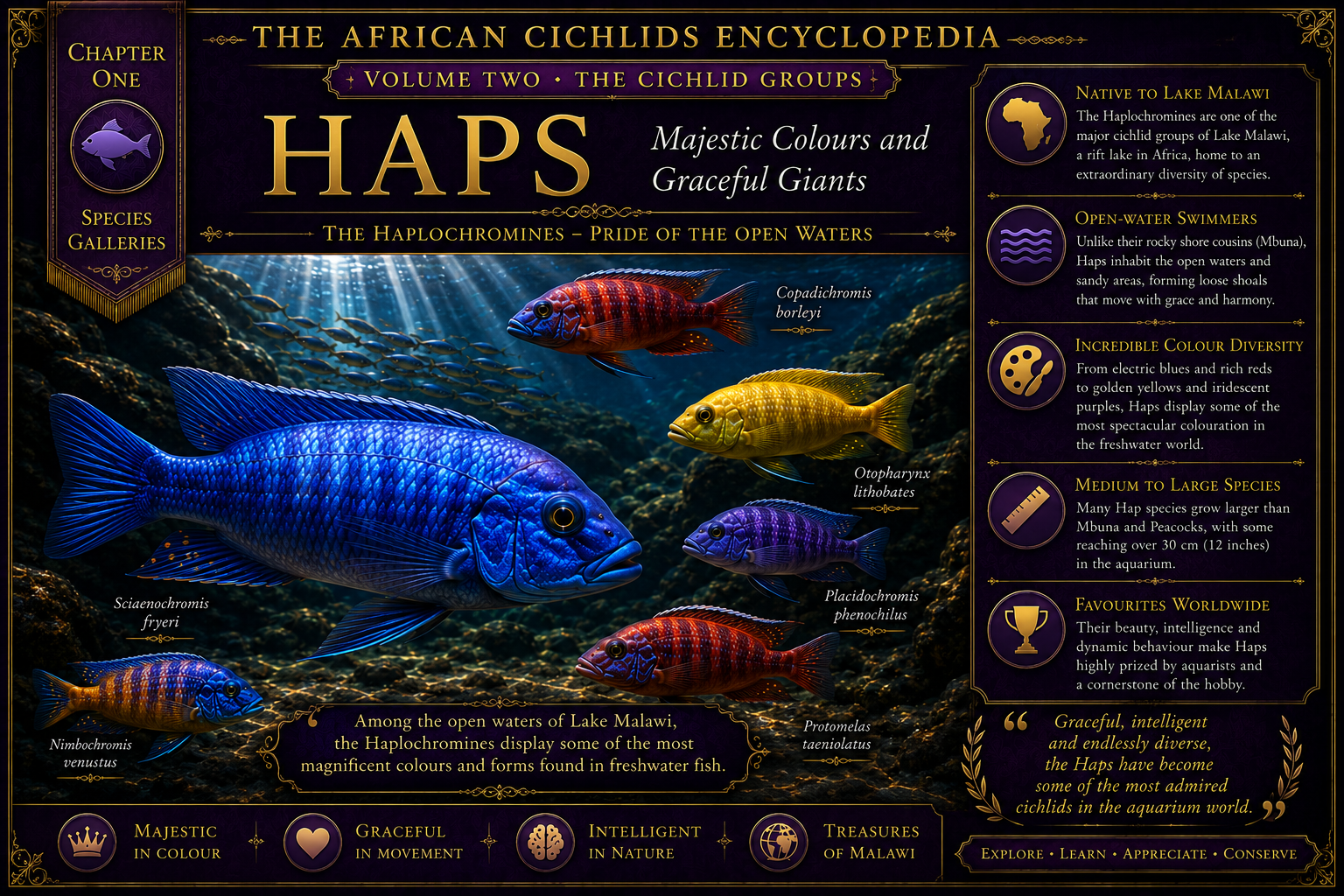
Majestic Colours and Graceful Giants
Among the open waters of Lake Malawi, the Haplochromines display some of the most magnificent colours and forms found in freshwater fish.
The Haplochromis family (commonly called Haps by aquarium hobbyists) is the single most massive, diverse, and evolutionarily successful group of cichlids in Africa. While the word Haplochromis technically refers to a specific scientific genus, in the aquarium hobby, "Haps" is used as a broad umbrella term for almost all open-water, non-Mbuna cichlids found across the African Great Lakes (Malawi, Tanganyika, and Victoria).
What Makes a Cichlid a "Hap"?
Unlike rock-dwelling Mbuna that stay pinned to underwater caves, Haps are designed for life in the wide-open waters and vast sandy b
- Sleek, Dynamic Body Shape: Haps generally have longer, more aerodynamic, torpedo-shaped bodies. They are built for speed and endurance rather than darting in and out of rock holes.
- The "Ugly Duckling" Transformation: Juvenile and female Haps are almost entirely uniform silver or gray, often featuring dark horizontal lines or spots for camouflage. However, once a male reaches maturity, he undergoes a breathtaking transformation, flashing brilliant iridescent blues, deep reds, metallic greens, and vibrant yellows.
- Maternal Mouthbrooding: Like most African cichlids, virtually all Haps are maternal mouthbrooders. The female carries the fertilized eggs and hatched fry inside her buccal cavity (mouth) for 3 to 4 weeks, completely refusing food until the babies are ready to be released into the wild.
Haps Across the Three Great Lakes
The Hap family adapted to entirely different lifestyles depending on which lake they evolved in:
1. Lake Malawi Haps (The Aquarium Favourites)
In Lake Malawi, Haps evolved into open-water cruising groups. They range from mild-mannered sand-sifters to fierce apex predators.
- The Predators: Species like the Livingstonii (Nimbochromis Livingstonii) or the Malawi Eyebiter (Dimidiochromis Compressiceps) are famous ambush hunters. The Livingstonii will actually play dead on the sand, waiting for tiny fish to swim close before snapping them up.
- The Sand Divers: The Utaka group (Copadichromis) travels in massive, peaceful open-water shoals, feeding entirely on tiny microscopic plankton drifting in the water columns.
2. Lake Victoria Haps (The Colour Bombs)
Lake Victoria is the true genetic home of the core Haplochromis genus. Because Lake Victoria is relatively shallow and green-tinted, these Haps evolved incredibly bright, high-contrast colouration so they could see each other through the murky water.
- Intense Neons: Species like the Flameback (Pundamilia Nyererei) or Ruby Green display colours that rival marine reef fish. They are smaller than Malawi Haps, live around shallow rock outcrops, and are highly prized in conservation circles today.
3. Lake Tanganyika Haps (The Minor Outliers)
Tanganyika has its own massive open-water species, but they belong to more specialized, distinct genetic lineages (like the Cyprichromis or Benthochromis) that act similarly to Haps, living in huge deep-water schools and feeding on plankton.
Keeping Haps in a Home Aquarium
If you want to dedicate a section of your site or an aquarium layout to Haps, they require very different care compared to typical rock-dwelling Mbuna:
- Massive Swimming Space: Because they are open-water cruisers, Haps require long tanks (ideally 5 to 6 feet minimum) with plenty of open, unobstructed swimming space across the front and center of the glass.
- Minimal Rockwork: While Mbuna need a tank completely packed with rock piles, a Hap tank looks best with just a few large, strategic rock pillars on the sides or back to establish boundary lines, leaving the middle wide open.
- Dietary Needs: Most Haps are carnivores, piscivores (fish-eaters), or insectivores. Unlike Mbuna—which will bloat and die if fed heavy proteins—Haps thrive on high-quality krill, mysis shrimp, and protein-rich cichlid pellets.
Popular African Hap Species
Livingstonii (Nimbochromis livingstonii)
Famous predatory ambush hunter that plays dead on the lake bed sand to lure unsuspecting tiny prey fish close before striking.
Flameback (Pundamilia nyererei)
A stunning rock-dwelling Haplochromine. Alpha males display intense neon red across their backs contrasted against bright green sides.
Malawi Eyebiter (Dimidiochromis compressiceps)
Features an incredibly narrow, compressed body built for stalking small fish through reed beds. Boasts deep electric blue coloring.
Ruby Green (Haplochromis sp. "Ruby Green")
A highly sought-after, rare hobbyist gem. Peaceful algae-grazer where dominant males flash emerald green and deep ruby red.