Species Identification Rules
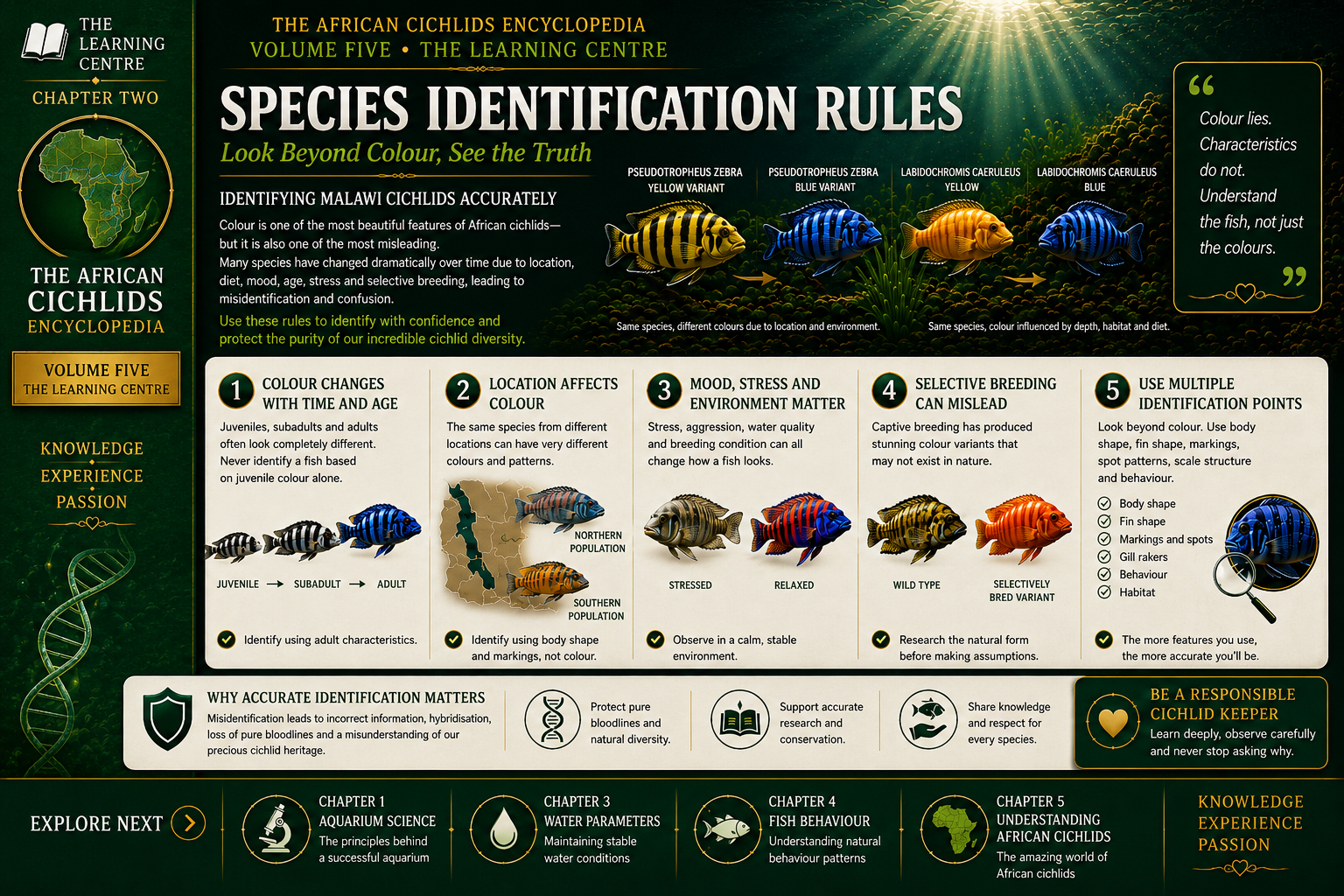
25 Years of Experience: The Rules of Malawi Species Identification
One of the most complex challenges in the African cichlid hobby is accurate species identification. Because Lake Malawi has produced hundreds of closely related species through rapid evolution, many fish look nearly identical—especially when young or stressed. Over my twenty-five years of experience, I have seen countless hobbyists purchase mislabelled fish or unknowingly buy accidental hybrids. Mastering species identification is critical to maintaining pure genetic lines, managing compatibility, and predicting adult behaviour.
"In the Learning Centre, we emphasize accuracy over guesswork. You cannot identify a Malawi cichlid simply by looking at a single color. You must analyze structural markings, egg-spot configurations, and collection locations. If you cannot confidently verify a fish's lineage, it should never be used for breeding."
1. Structural Taxonomy Over Shifting Colours
Colour is the least reliable tool for identifying an African cichlid. A dominant male might be electric blue, while a subdominant male of the exact same species will turn completely brown to escape a beating. Instead, train your eyes to look at permanent structural markers:
- Barring and Striation Patterns: Count the vertical bars or horizontal stripes. A true Pseudotropheus demasoni has sharp, crisp, dark blue-black vertical bars that extend clearly into the dorsal fin. Look at whether the markings are purely vertical (typical of many Mbuna) or horizontal stripes (typical of the Melanochromis genus).
- Jaw and Mouth Structure: Look closely at the fish's mouth shape. True Mbuna have specialized, down-turned jaws designed for scraping rocks. Open-water Haps have terminal or upturned mouths built for catching moving prey. The shape of the skull profile (sloping vs. blunt) is a permanent genetic footprint.
- Egg-Spot (Ocelli) Architecture: Analyze the anal fin of the fish. The number, sizing, and color alignment of the round egg-spots can help differentiate closely related species, particularly within the Metriaclima and Labidochromis genera.
2. The Danger of Shaking the Genetic Tree: Hybrids
Lake Malawi cichlids cross-breed with alarming ease in a home aquarium if the stocking conditions are incorrect. This produces lookalike hybrids that pollute the hobby's bloodlines.
- The Peacock Problem: The Aulonocara (Peacock) genus is heavily compromised by hybridization. Unscrupulous line-breeding has created variations that do not exist in nature. If you buy a "mixed Peacock" tank pull, it is highly likely a genetic hybrid.
- The Zebra Complex: Many Mbuna in the "Zebra" complex will readily cross-breed if a male cannot find a female of his own exact species. These hybrid offspring often display muddy, irregular barring or unusual colour blending that doesn't match any wild collection locality.
Species Identification & Purity Checklist
Use this scientific verification checklist before purchasing a new fish or dedicating a tank to breeding.
- [ ] Scientific Locality Check: Does the fish come with a recognized "location variant" name (e.g., Labidochromis caeruleus "Lion's Cove")?
→ Why: Wild cichlids vary distinctly by the specific island or reef they were collected from. True variants command respect in the hobby. - [ ] Visual Symmetry Verification: Are the vertical bars or markings perfectly symmetrical and unbroken on both sides of the fish's body?
→ Why: Drifting, broken, or "swirling" bar patterns are one of the primary physical indicators of a low-quality accidental hybrid strain. - [ ] Phenotype Consistency: Does the female of the species match the known wild phenotype (colourless, yellow, or barred) required for that exact male?
→ Why: Ensuring the female is visually correct guarantees you aren't accidentally pairing a pure male with a lookalike female of a different species.