Understanding African Cichlids
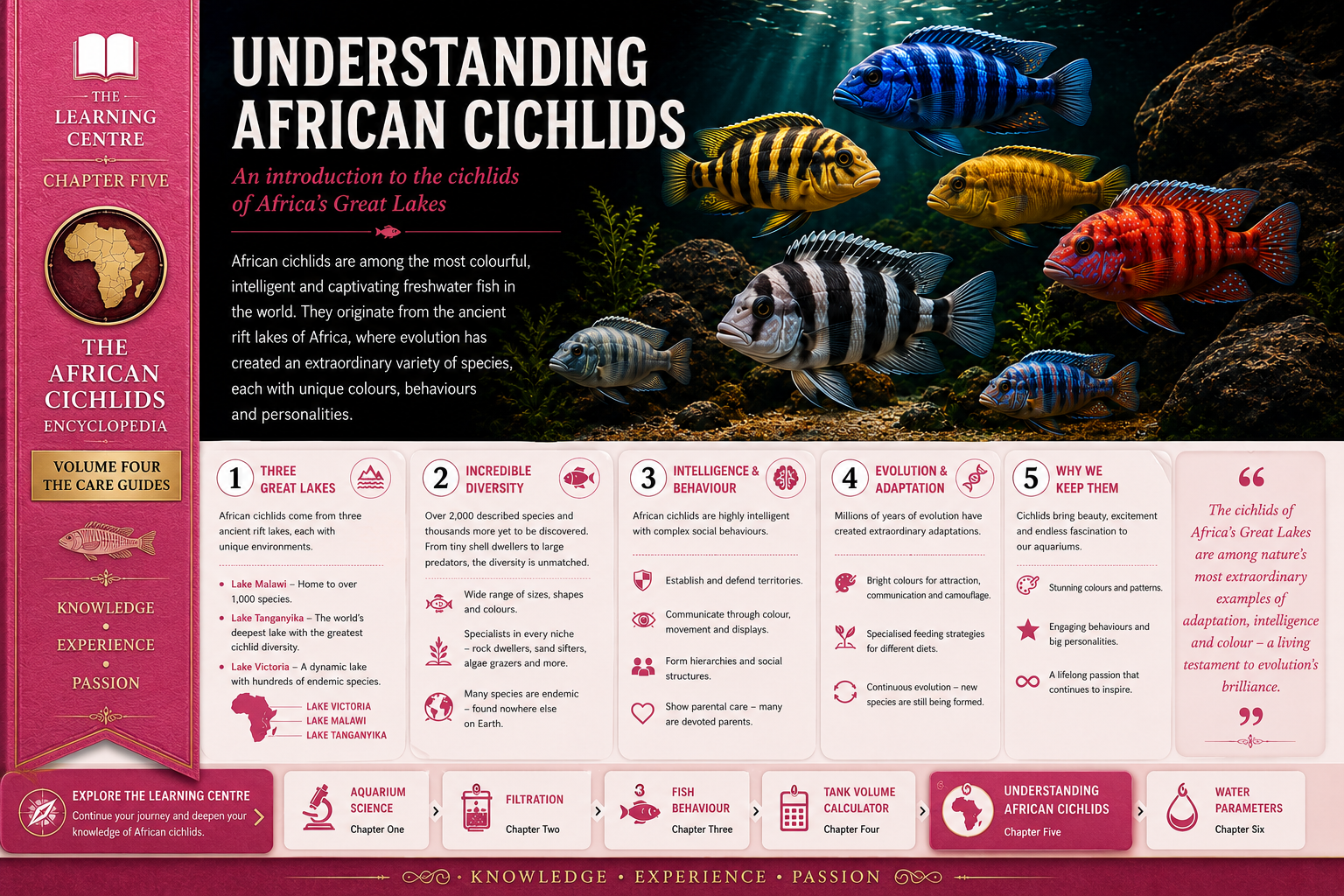
Understanding African Cichlids
25 Years of Experience: The Evolutionary Wonders of the Rift Valley
To truly look after Lake Malawi cichlids, you must first understand the ancient world that forged them. Many beginners treat African cichlids like standard tropical fish, expecting them to behave like South American Tetras or Asian Barbs. This is a fundamental mistake. Over my twenty-five years of working with these creatures, I have found that their unique water needs, intense dietary demands, and relentless territorial instincts are not random quirks—they are hardwired survival traits driven by millions of years of isolated evolutionary pressure.
"In the Learning Centre, our philosophy is simple: to understand the fish, you must understand their home. Lake Malawi is not a regular body of fresh water; it is a highly mineralized inland sea born from a massive geological tear in the Earth's crust. Every behaviour you see in your glass tank today was perfected millions of years ago in Africa."
1. The Great Rift Valley: An Alkaline Inland Sea
Unlike standard rivers or rainforest basins that are fed by soft rainwater and decaying organic leaf litter, Lake Malawi was formed by violent tectonic movement:
- The Volcanic Crucible: As the African continent slowly pulled apart, it created the East African Rift Valley—a massive, deep trench that filled with water. Because the lake bed sits atop volcanic rock, rich deposits of sodium, magnesium, and calcium carbonate have continually leached into the water for millennia.
- An Unchanging World: This geological isolation turned Lake Malawi into a closed, highly stable ecosystem. The water has remained exceptionally hard, alkaline, and crystal clear for millions of years. Because this environment never fluctuates in the wild, African cichlids have completely lost the ability to tolerate soft, acidic, or rapidly changing water conditions.
2. Adaptive Radiation: The Explosion of Species
Lake Malawi is a living laboratory of evolution, famous for a biological phenomenon known as adaptive radiation. From just a few ancestral species, the lake has produced over 800 distinct cichlid species found nowhere else on Earth.
- Niche Specialization: Because competition for food in a closed lake is fierce, different groups of cichlids evolved hyper-specific methods to survive. One group claimed the rocky coastlines (the Mbuna) and developed specialized scrapers to graze on algae. Another group moved into the open, deep water (the Haps) and evolved into streamlined predators.
- The Aquarium Impact: This explosive specialization is exactly why you cannot mix different feeding groups or skip our strict compatibility guidelines. They are not merely different-looking fish; they are entirely different biological machines designed to consume completely opposite resources.
3. The Instinctive Drive for Territory
In a lake packed with hundreds of species competing for the exact same patches of rock, space is the ultimate currency. This evolutionary crowding is the root cause of the aggression we manage in our aquariums today.
- The Rocky Real Estate: For an Mbuna, a single cave among the boulders provides a shelter from predators, a grazing ground for food, and a safe theater to attract passing females. If a male loses his rock, he loses his lineage.
- Genetically Programmed Aggression: When you place these fish into a home aquarium, they do not realize the food is free and there are no predators. Their ancient programming tells them they must fight to hold their territory at all costs. Overstocking the aquarium simply exploits this instinct by making boundaries impossible to define, safely diffusing their competitive energy.
Evolutionary Understanding Checklist
Keep these three core biological concepts in mind to guide every husbandry decision you make on your fishkeeping journey.
- [ ] Evolutionary Isolation: Do you treat your cichlids as specialized lake-dwellers rather than generic tropical fish?
→ True Meaning: Recognizing that their bodies are finely tuned to hard, mineral-rich environments and cannot adapt to soft water setups. - [ ] Dietary Integrity: Do you respect the hyper-specialized feeding traits forged by adaptive radiation?
→ True Meaning: Never feeding heavy meat diets to rock-grazers whose long intestines were exclusively engineered to process fibrous algae. - [ ] Crowding Psychology: Do you view your heavily stocked tank as a controlled replication of crowded wild reefs?
→ True Meaning: Understanding that strategic overcrowding is a scientifically sound method used to disrupt the strict, territorial boundaries of the wild.