Plight of the Victorians
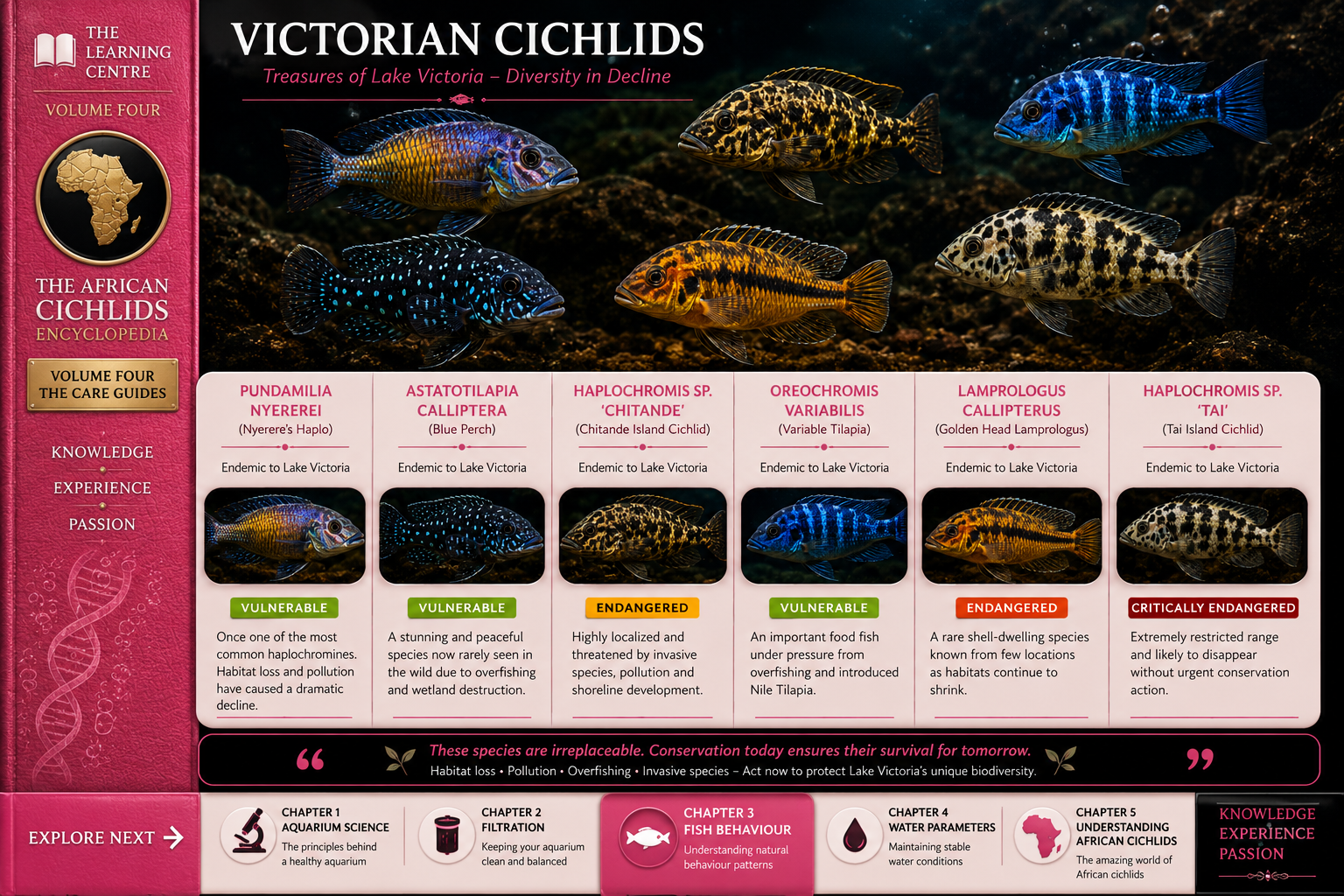
The Plight of the Victorians: The World's Greatest Ecological Collapse
To look at a brightly coloured Victorian cichlid in a home aquarium is to look at a living ghost. Over the course of just a few decades, Lake Victoria transformed from the planet's most vibrant evolutionary cradle into an ecological warning story.
1. The Speciation Miracle
Before the 1950s, Lake Victoria held a biological world record. In a span of just 15,000 years—a blink of an eye in evolutionary terms—a tiny handful of ancestral river fish evolved into more than 500 completely unique species of haplochromine cichlids.
Every single species evolved a hyper-specialized role:
- Some became strict algae scrapers, keeping the lake water crystal clear.
- Others evolved into specialized snail-crushers, crab eaters, or insect hunters.
- Some even became "paedophages," specialized fish that would gently bump mouthbrooding females to steal and eat their eggs.
This perfect, self-sustaining ecosystem made Lake Victoria the most productive freshwater body on Earth.
2. The Introduced Monster: The Nile Perch
In the 1950s, the colonial British government sought to transform the lake into an industrial commercial fishery. To do this, they introduced the Nile Perch (Lates Niloticus)—a massive, predatory fish that can grow up to 2 metres long and weigh over 200kg.
For a couple of decades, the perch population remained low. Then, in the late 1970s, a tipping point occurred, and the Nile Perch population exploded exponentially.
The perch treated the helpless, small native cichlids as an all-you-can-eat buffet. In less than ten years:
- Cichlids plummeted from making up 80% of the lake’s total fish mass down to less than 1%.
- Over 200 to 300 entirely unique species of cichlids were driven to absolute extinction in a matter of years
3. The Domino Effect (The Ecosystem Collapses)
The loss of the fish didn't just hurt the cichlids; it broke the lake itself. Because all the algae-eating cichlids vanished, the lake's natural filtration system disappeared.
Massive, toxic green algae blooms exploded across the surface. As the unchecked algae died and rotted, it sucked all the oxygen out of the deep water, turning the bottom of Lake Victoria into a giant, suffocating dead zone where no fish can survive.
4. The Ark: How Hobbyists Saved the Survivors
When the crisis hit, public aquariums and private hobbyists realized that if they didn't act immediately, every single Victorian fish would vanish forever.
Teams rushed to Africa to collect "founder stocks" of the remaining cichlid species hiding in shallow rocky cracks where the massive Nile Perch couldn't reach them. Programs like the CARES Preservation Program and the Species Survival Plan (SSP) were formed.
Today, several species—such as the Python Island Hap or the Zebra Obliquidens—are considered completely extinct in the wild, meaning they exist purely because dedicated fish keepers are keeping their genetic lines alive in home aquariums.