Lake Victoria
Lake Victoria: The Great African Sea
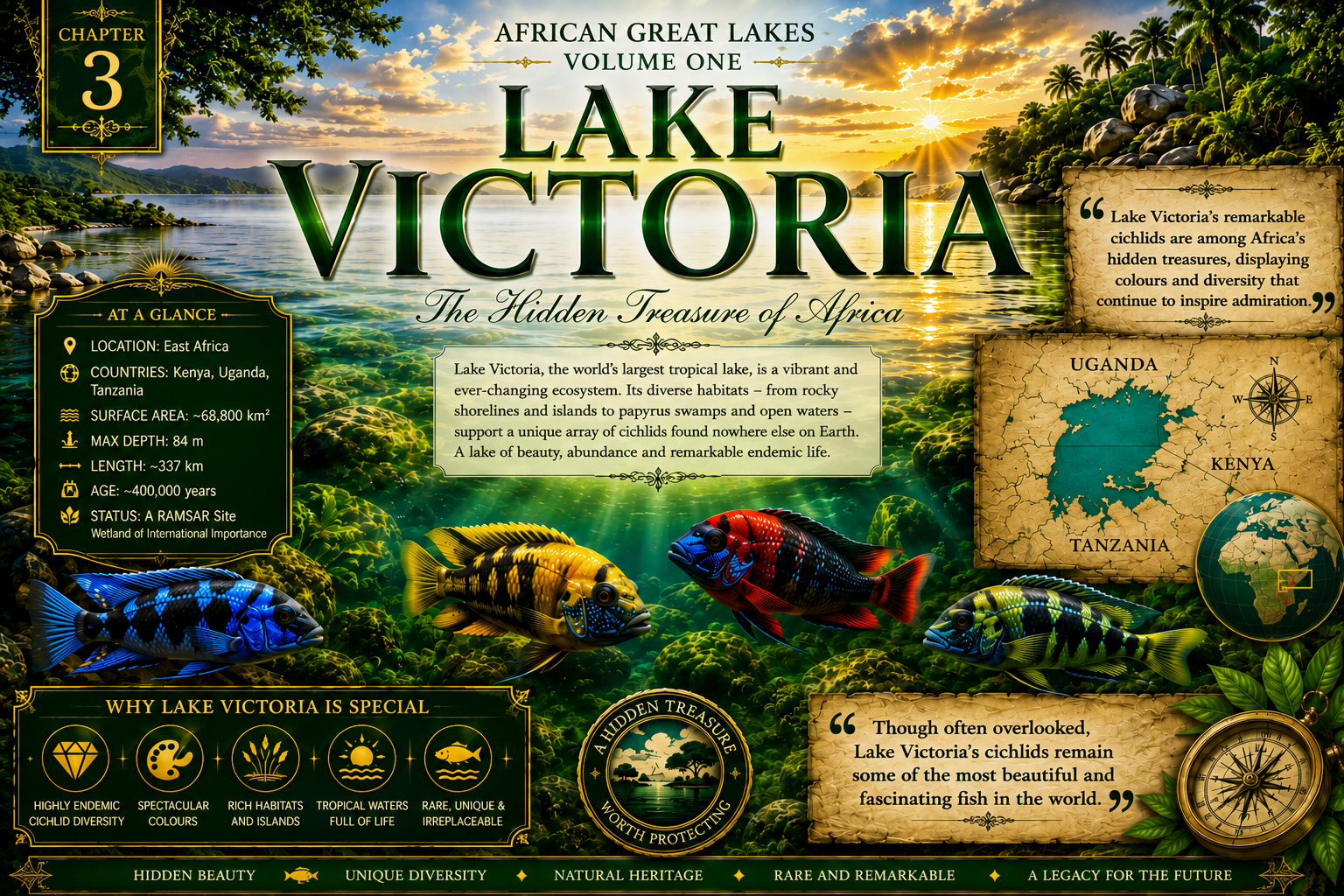
Welcome to Lake Victoria (known natively as Nnalubaale), the sprawling crown of the African Great Lakes. While it lacks the immense tectonic depth of Malawi and Tanganyika, it boasts one of the most intense, tragic, and fast-moving evolutionary histories on Earth, making it a critical haven for some of the rarest freshwater fish in the world.
Location, Scale & Geography
- The Giant's Footprint: Spanning a massive 59,947 square kilometres (23,146 sq miles), Lake Victoria is shared by three countries: Tanzania (51%), Uganda (45%), and Kenya (4%).
- The Tropical World Record: It is the largest tropical lake on Earth and the second-largest freshwater lake by surface area, surpassed only by Lake Superior in North America.
- Shallow & Productive: Unlike the deep rift valley fractures, Victoria fills a shallow tectonic depression between two mountain ridges. Its maximum depth is a mere 80 metres (260 feet), meaning sunlight penetrates deeply, making the water column highly productive and full of life.
- The Source of the Nile: The lake acts as the primary reservoir and the geographical birth origin of the famous White Nile, which flows northward out of Uganda toward Egypt and the Mediterranean Sea.
| Parameter | Native Lake Values | Aquarium Target |
|---|---|---|
| Water Temperature | 22°C – 27°C (71°F – 81°F) | 24°C – 26°C (75°F – 79°F) |
| pH (Alkalinity) | 7.2 – 8.2 (Mildly Alkaline) | 7.4 – 8.0 |
| General Hardness (GH) | 2 – 7 °dGH (Relatively Soft) | 5 – 12 °dGH |
| Carbonate Hardness (KH) | 4 – 7 °dKH | 5 – 9 °dKH |
| Water Clarity | Variable (Turbid/Green-tinted) | Good Water Movement |
The People & Lakeside Culture
- Ancient Kingdoms: The shores and islands of Lake Victoria have been home to powerful historic civilisations for centuries, including the Kingdom of Buganda. In local folklore, the lake is revered as a powerful living entity that brings weather, life, and fertility to the land.
- The Floating Economy: The lake supports one of the largest freshwater fisheries in the world, providing food, security, and a livelihood for over 30 million people living along its basin.
- Languages: Luganda, Luo, and Swahili are the dominant languages spoken across the sprawling fishing ports, busy markets, and islands like Ukerewe.
The Rare Fish: An Evolutionary Survival Story
Lake Victoria is famous for a biological phenomenon: over 500 species of colourful haplochromine cichlids evolved here in a span of just 15,000 years - the fastest evolution ever recorded in vertebrates.
However, the introduction of the predatory Nile Perch (Lates Niloticus) in the 1950s wiped out hundreds of native species. Today, the surviving cichlids are incredibly rare, highly prized, and fiercely protected by aquarium conservationists.
Rare and Stunning Target Species:
- The Flameback Cichlid (Pundamilia Nyererei): One of the most famous and striking fish left in the lake. Found around rocky outcrops like Makobe Island, dominant males flash an intensely brilliant neon red across their backs and a bright yellow-green belly.
- The Ruby Green Cichlid (Haplochromis sp. "ruby green"): A highly sought-after, rare hobbyist gem. These fish are relatively peaceful algae-grazers where the dominant males display a beautiful, shimmering mix of emerald green and deep ruby red.
- The Zebra Obliquidens (Haplochromis Latifasciatus): A critically rare species in the wild, instantly recognisable by its bold, vertical black and white zebra stripes overlaid with bright red and yellow highlights on the male's chest.
- The Mukene (Rastrineobola Argentea): A tiny, shimmering non-cichlid lake sardine. While the rare cichlids hid in the rocks to survive the Nile Perch, the Mukene exploded in numbers in the open water. Caught at night using floating lanterns, it has become the most important source of protein and food security for the local people.
Against all odds, the native cichlids are making a comeback. Read the full evolutionary story: [Lake Victoria's Modern Recovery]