Filtration
25 Years of Experience: The Over-Filtration Strategy for Lake Malawi
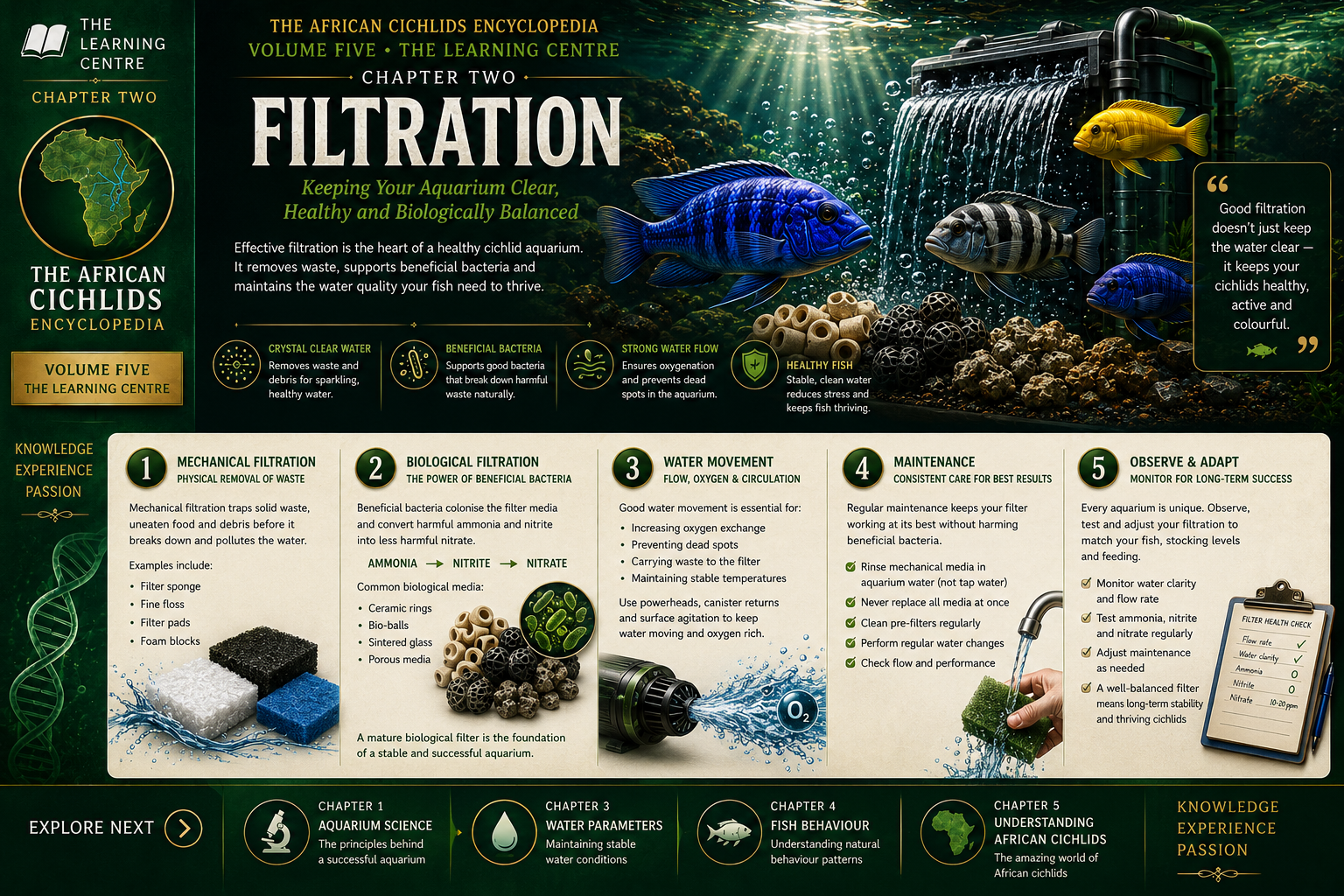
If you filter a Lake Malawi cichlid aquarium using standard community tank guidelines, your setup is destined for failure. Because we deliberately overstock Malawi tanks to dilute territorial aggression, the sheer biological waste production and physical debris load are massive. Over my twenty-five years of maintaining these environments, I have developed a strict rule: you must over-filter the water aggressively. Your filtration system needs to act as a high-powered treatment plant, keeping the water crystal clear and chemically pristine.
"In a standard aquarium, filtering the tank volume 4 times per hour is completely acceptable. In a Lake Malawi setup, that is a recipe for stagnation. You should aim for a absolute minimum turnover rate of 10 times the tank volume per hour. If your tank holds 300 litres, your filtration systems must move at least 3,000 litres of water every single hour."
1. Choosing the Right System: Canisters vs. Sumps
To move that volume of water while holding enough physical filter media to host your massive beneficial bacteria colonies, you need specialized hardware. Two systems dominate successful Malawi setups:
- External Canister Filters (The Hobbyist Workhorse): Running two large external canister filters on a single Malawi tank is my preferred configurations. Dual canisters provide excellent safety redundancy—if one motor fails or loses flow, the second canister keeps the ecosystem alive. It also allows you to stagger your cleaning schedule (Filter A on week one, Filter B on week three) so you never accidentally wipe out all your beneficial bacteria at once.
- Aquarium Sumps (The Elite Solution): For larger systems exceeding 400 litres, a customized sump system built into the cabinet below is unparalleled. Sumps offer a massive water volume capacity, unmatched space for biological media, and make maintenance incredibly easy because you can swap out mechanical filter socks or floss in seconds without disconnecting heavy hoses.
- A note on Hang-On-Back (HOB) and Internal Filters: These are generally insufficient as primary filtration for adult Malawi setups. They lack the media capacity required to handle the high bioload and cannot generate the directional flow patterns needed to clear waste from complex rockwork.
2. The Three Phases of Cichlid Filtration
To maximize efficiency, the media inside your canisters or sump must be stacked in a highly specific structural sequence to process waste effectively:
- Phase 1: Mechanical Filtration (The Trap): Water must first pass through coarse, medium, and fine sponges or filter floss. This physical barrier traps solid fish waste, uneaten food, and loose plant material before it can reach your biological media. In a Malawi tank, mechanical media clogs quickly and must be rinsed frequently in old tank water to prevent flow drop.
- Phase 2: Biological Filtration (The Engine): Once cleared of solid debris, the water forces its way through highly porous media like ceramic rings, sintered glass matrices, or pumice stone. This is where your massive colonies of nitrifying bacteria live. Because Malawi cichlids require pristine parameters, never skimp on biological media quality—this is what keeps your ammonia at zero.
- Phase 3: Chemical Filtration (The Polisher): The final optional stage utilizes carbon or synthetic resins (like Purigen) to strip microscopic dissolved organics, heavy metals, and discoloration from the water. It provides that striking, "fish floating in mid-air" clarity that makes a well-managed Rift Lake display look so spectacular.
3. Water Turnover vs. Structural Flow Dynamics
Achieving a high turnover rate on paper is pointless if the water is only moving in a small loop in one corner of the tank. Malawi cichlids produce heavy solid waste that sinks quickly. To keep this waste from settling into toxic "dead spots" behind your rock fortresses, you must master directional water flow.
- The Circular Current: Position your filter intakes near the bottom glass in the rear corners of the tank. Aim your filter outputs or spray bars across the top surface toward the opposite glass panel.
- Wavemakers and Powerheads: Supplement your primary filters with a strategic wavemaker mounted near the top of the tank, angled downward toward your rockwork. This creates a continuous, sweeping conveyor belt of current along the substrate, gently rolling fish waste out from the caves and directly into the path of your filter intake tubes before it can break down into nitrates.
Filtration Efficiency Checklist
Verify these technical filtration rules to confirm your mechanical hardware is fully optimized for a heavy Malawi cichlid bioload.
- [ ] The 10x Hourly Turnover Rule: Is your combined filter manufacturer flow rate at least 10 times your total aquarium volume?
→ Formula: A 300L tank needs a minimum 3,000 L/H rating. If running dual filters, ensure their combined totals hit this metric. - [ ] Surface Agitation Level: Are your filter outputs actively breaking the surface of the water, creating continuous ripples or bubbles?
→ Why: Nitrifying bacteria require vast amounts of dissolved oxygen to process ammonia. Strong surface agitation drives essential gas exchange (oxygen in, carbon dioxide out). - [ ] Mechanical bypass prevention: Is your filter pad media cut perfectly flush against the walls of your canister trays?
→ Why: Gaps allow dirty, debris-filled water to bypass your mechanical pads, rapidly clogging your expensive biological media with raw fish waste and reducing biological efficiency.