Aquarium Designs
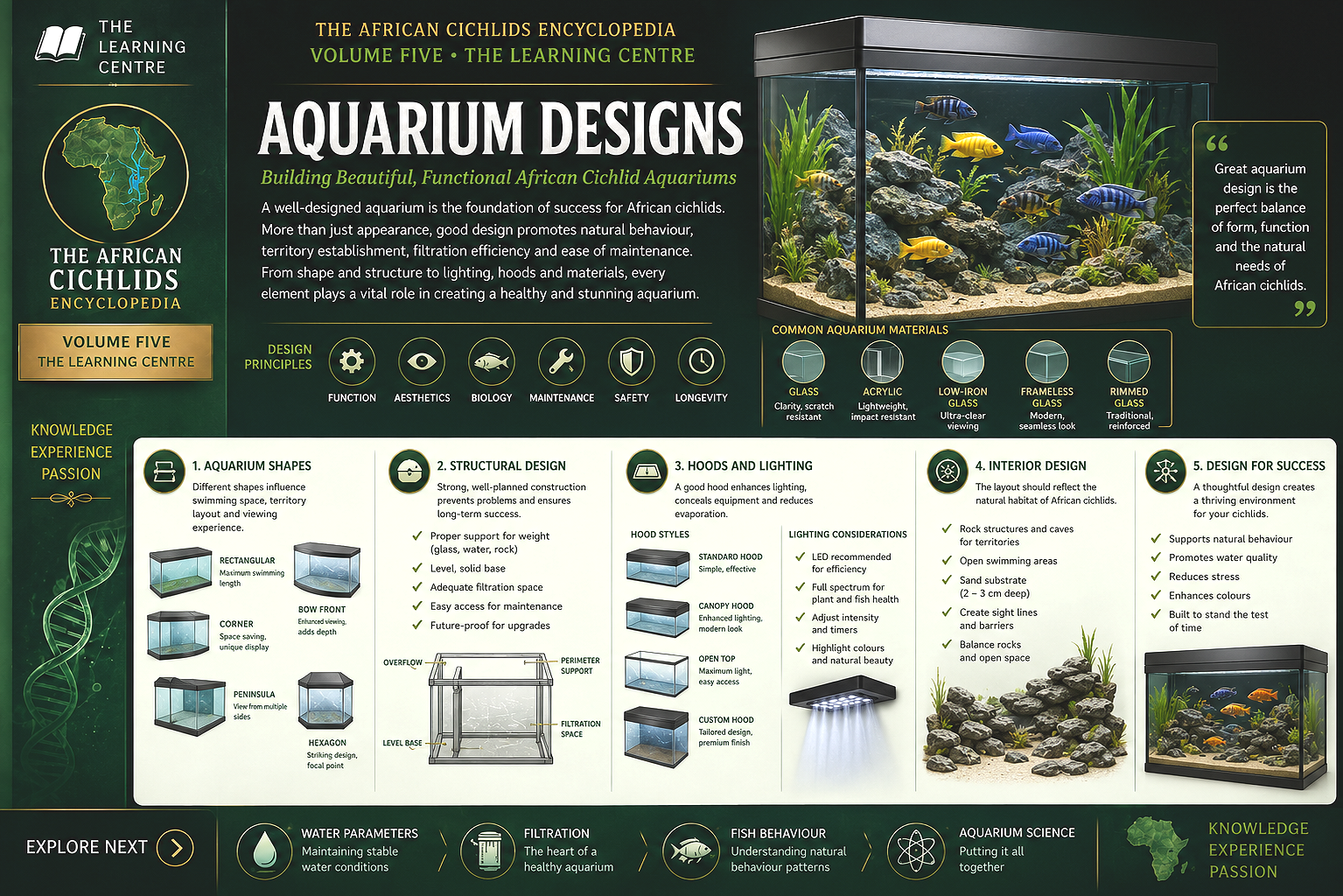
25 Years of Experience: Choosing the Right Aquarium Architecture
When planning a Lake Malawi aquarium, most hobbyists focus entirely on volume—how many litres of water the tank can hold. However, after twenty-five years of designing, building, and maintaining these setups, I have learned that the physical architecture of the tank is just as critical as its size. The structure, shape, and material of your aquarium dictate how well you can manage territory, how safely you can stack hundreds of kilograms of rock, and how your fish will behave dynamically within the space.
"In the Learning Centre, we look at the engineering behind the hobby. For a Malawi setup, the footprint of the tank is infinitely more valuable than its height. You are building a horizontal world of rock boundaries and open swimming lanes; choosing the wrong tank shape or material can severely limit your stocking success before you even add water."
1. Tank Material: Glass vs. Acrylic
The debate between glass and acrylic is especially impactful for a Malawi setup due to the heavy use of rockwork and the digging habits of the fish:
- Glass Aquariums (The Time-Tested Choice): Glass is highly scratch-resistant, which is a massive advantage in a cichlid tank. Because Mbuna and Haps constantly lift and spit sand, stray grains frequently get caught between algae magnets and the walls. Glass can withstand this daily wear much better than acrylic. However, glass is incredibly heavy and more brittle under localized impact points if a rockwork collapse occurs.
- Acrylic Aquariums (The Structural Fortress): Acrylic is visually clearer, significantly lighter, and structurally stronger against impact than glass. It absorbs thermal shocks and pressure points from heavy rock fortresses beautifully. The major downside? Acrylic scratches incredibly easily. A single disgruntled cichlid spitting a piece of rough aragonite against the wall can leave a permanent blemish.
- The 25-Year Verdict: For tanks under 500 litres, standard or low-iron glass is almost always preferred for its scratch resistance. For massive predator Hap setups exceeding 700+ litres, acrylic becomes highly attractive for its structural integrity and weight reduction.
2. Geometric Shapes: Footprint Over Height
Aquarium manufacturers offer beautiful column tanks, bowfronts, hexagons, and deep cubes. While these look stunning in a living room, they are fundamentally flawed for Lake Malawi communities.
- The 'Long' Blueprint: Malawi cichlids are horizontal swimmers and strict territory holders. A tall, narrow column tank leaves no floor space for multiple males to establish boundaries. Instead, prioritize "Long" or "Breeders" dimensions. A standard 120cm long tank provides vastly more usable territory than a 90cm tank that is simply taller to achieve the same volume.
- The Depth Factor (Front-to-Back): Look for tanks with a wide front-to-back depth (ideally 50–60cm or more). A wider footprint allows you to build massive rock structures down the middle or back of the tank while still leaving a clear, unobstructed sand lane in the front for swimming and feeding.
- Avoid Hexagons and Cylinders: These shapes restrict linear swimming boundaries, disrupt the high-flow current patterns required to move debris to your filter intakes, and make it incredibly difficult to safely secure heavy, interlocking stone piles.
3. Rimmed vs. Rimless and Bracing Systems
The physical reinforcement of the tank structure determines how safely it can hold the intense weight and hydro-dynamic pressure of a cichlid environment:
- Euro-Bracing: This is a highly recommended design feature for larger glass cichlid tanks. Euro-bracing consists of glass strips siliconed horizontally along the top perimeter of the tank walls. This drastically reinforces the glass against bowing without requiring a thick, ugly plastic center brace that blocks your lighting and restricts your access when placing large boulders.
- The Rimless Warning: While ultra-clear, rimless glass tanks look incredibly modern and minimalist, they require flawless glass thickness and offer zero upper protection. If you choose a rimless design, your glass thickness must be rated higher to cope with the heavy shifting weight of a rock-centric aquascape, and you must design a custom flush-fitting lid to prevent jumpers.
Aquarium Design Selection Checklist
Use these architectural guidelines when shopping for your next tank structure to guarantee it can safely support a Lake Malawi community.
- [ ] Minimum Length Check: Is the front glass panel at least 120cm (4 feet) long for Mbuna or 150cm (5 feet) long for open-water Haps?
→ Why: Shorter lengths do not provide enough physical distance for subdominant fish to escape the line of sight of an aggressive alpha male. - [ ] Glass Thickness Rating: Is the glass thickness at least 10mm to 12mm for mid-to-large setups?
→ Why: Thicker glass provides an essential safety margin against accidental impacts from heavy rocks during an aquascape re-shuffle. - [ ] Overflow & Plumbing Design: If the tank is pre-drilled, are the overflows designed to handle massive, high-turnover flow rates without bottlenecking?
→ Why: Malawi filtration relies on moving vast amounts of water rapidly to keep the heavy bioload under control.